Wednesday, October 10, 2012

Read my lips! Or don't

As a guy whose hearing, shall we put it generously, "kind of sucks," I find myself reading people's lips without even realizing I'm doing it. In noisy bars, this can come in handy. While watching sporting events, it can be amusing: no, that coach wasn't loudly telling the referee to have a great day.

And during times like these (and by that I mean near the end of a long U.S. presidential election campaign), it can be hysterical. Because even though I KNOW Jim Lehrer isn't saying "and then when he died, they had him stuffed. Like that water buffalo--stuffed." his lips sure are moving in a way that closely matches those words. It also helps that I am a sucker for absurd humor.


To put it another way, this made the presidential debate not just watchable and entertaining, but possibly even more informative than the real thing... even without sound.

Wednesday, October 3, 2012

Politics is a bloodsport


As I have mentioned before, it is kind of a blessing living overseas during a presidential election year: not only is voting easier but we are spared the barrage of campaign commercials.

I'm sure politics has actually always been like this, but to my eye it has become much more polarized--a sport rather than a discussion of competing ideas--and vitriolic. That makes it less interesting and more annoying. It is often juvenile and easy to ignore.

So let's talk about juvenile behavior for a minute. Way back in the day, I spent four summers taking some classes in North Carolina. We were a bunch of junior high and high school students basically living like college students: on our own except for showing up to class and meals. And after lunch, there would invariably be a crowd of people gathered around the cafeteria's Mortal Kombat machine. Oh, how we would drop quarters into its bottomless maw.

I was terrible at it, of course. I could barely make the characters punch and kick, let alone pull off the complicated combination of button pushes and joystick tugs that would trigger a signature move. It was fun (and oddly social) to watch, but not very interesting to play.

But today, I was introduced to a project that made both the video game and politics seem... well... awesome. Behold:


Paul's "church and state" move and "red vest straitjacket" seem unbeatable, honestly. But Romney was able to easily fight off him and Herman Cain's "creepy ad" power move. Impressive! And round 2:


There are a lot of cheap shots, but hey--art imitates life, right? And the Republican primary was indeed pretty brutal, rhetorically speaking. How will the rest of the battles shape up? We have less than five weeks to find out. Here's hoping the actual campaign has an exciting finishing move... except, of course, with a lot less blood.

Monday, October 1, 2012

Whatever floats your boat


China has been in the news a lot lately. The presumptive next president, Xi Jinping, disappeared for a bit last month. The country was kept in the dark about the Communist Party meeting in which the country's leadership will be swapped out, then told it would be delayed until November. The economy continues to sputter.

But the most important news of all--if you get your news from Chinese media--is a fancy new aircraft carrier that was officially "launched" last week. Here's the thing, though. It's not fancy. It's not new. It's not armed. And there is no one trained to use it.

You would never know this from all the attention it is getting, though.

The aircraft carrier was originally launched by the Soviet Navy in 1988. But of course the Soviet Union was in its last days at that point, and the ship--eventually christened the Varyag--was never fully outfitted for combat. By the mid-90s, it had been stripped of pretty much any useful machinery, including engines. And in 1998, China bought it.

That's the provenance of the Chinese carrier, now called the Liaoning. Now let's talk about its capabilities.

As designed, it was essentially a complement to a larger fleet, not the centerpiece of a battle group. Its lack of catapults limited the types of planes it could use; essentially, it could provide combat patrols over the fleet and conduct limited anti-ship or interdiction missions with its two dozen or so aircraft. In short, its purpose is not to project massive offensive firepower, but to provide cover for missile cruisers. (Indeed, another type of Soviet carrier tried to combine both roles.)

Ski jump: great for catching righteous air, but not for launching righteously large aircraft.

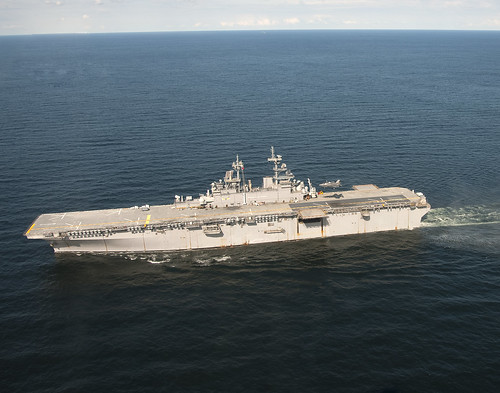
This is a sharp contrast to U.S. carrier design. America basically fields two types: supercarriers and amphibious assault craft.

Supercarriers--typified at the moment by the Nimitz class--are meant to project power. They are the focal point of a carrier strike group, which involves other surface ships and submarines, and are what battleships were 75 years ago: the big guns. They carry nearly 100 aircraft, including strike fighters, airborne warning and control planes, electronic warfare, helicopters, and so on. Because it is catapult-equipped, it can also launch heavier air-refueling tankers--and that means the carrier's fighters can theoretically strike targets or patrol airspace over a thousand miles.

Amphibious assault craft are the province of the U.S. Marines and can be equipped in a variety of ways. Overall, though, the Wasp class carries a mix of several dozen fixed-wing aircraft and helicopters, plus a bunch of Marines and a complement of amphibous-landing craft: either LCAC hovercraft or other vehicles.

They also are used to test-fly awesome-looking next-generation fighters.

The Liaoning is nearly the length of a Nimitz-class ship--just a few hundred feet shorter at the waterline. It's a bit heavier than the Wasp class, weighing in at about 50,000 tons compared with 41,000. (Nimitz-class ships typically displace more than 100,000 tons.)

But the important point here is that it is a military match for neither. The nuclear-fueled Nimitz can travel indefinitely, limited only by food supplies. The Wasp has a range of more than 9,000 nautical miles. The Laioning has a range of only 3,800 nautical miles.

Worse, it can't land troops like the Wasp, nor can it control as much airspace as a Nimitz. Designed to protect other ships, the Laioning would essentially have to devote its entire air wing to protecting itself, leaving it with no offensive firepower to spare. In short, it can't project power or even provide a punch beyond what a group of missile cruisers would give on their own. It is a target.

Unfortunately for the Liaoning, that's not even the end of the story.

This is China's first aircraft carrier. That means that the military must now train several thousand seamen to operate the thing--no small feat considering the number of moving parts in modern carrier operations. With such a tiny margin for error and lots of munitions and jet fuel around, mistakes have major consequences. And actually landing on a carrier? That's one of the most difficult feats in aviation. Chinese pilots must be trained to fly carrier-capable aircraft. That aircraft will be the J-15, a copy of the Su-33. And the thing about the J-15 is that it doesn't exist yet.

To sum up, China now has a 25-year-old carrier that can't go very far and has no airplanes or trained pilots to fly them.

In the PLAN's defense, you have to start somewhere. The Liaoning is, at its heart, a proof-of-concept system. Crews will train there, the J-15 will eventually be test-flown there and a decade or so down the line, the navy will have the capability to run a combat-capable carrier. Is the Liaoning that carrier? Not a chance.

So why all the fanfare about this thing? It's simple. If China can get the world to worry about its aircraft carrier, bigger threats--like economic slowdowns and messy power transfers--will disappear in its wake. And that's more dangerous than the Liaoning will ever be.

Friday, September 28, 2012

Democracy in action


My fellow Americans (and everyone else), I come before you today to discuss that most American of all Greek-invented activities: voting. It is an act that is simple on its face--voicing support for someone to represent you in creating legislation and governance--but complex in execution and effect. Sometimes there's no one out there who represents your ideals. Sometimes the person who DOES represent your ideals has no shot of winning. And sometimes the person you vote for and wins ends up not really doing what you expected.

All part of the process. It's one I have been enjoying and growing into for nearly two decades now. Living abroad has given me a different perspective on democracy in a lot of ways, of course; in the Middle East, democracy doesn't really exist, so it was always interesting to explain to people that, in my opinion, it was better for people in a given country to be able to peacefully kick out whoever was running the country than to just allow someone to be in charge because of their surname. The results are messy and almost always imperfect, but on the whole, pretty nifty.

This year will be the first time I vote in a general election while living overseas. I know, I know… there was a congressional election in 2010, and I am a terrible American who did not participate. This was not out of protest or apathy, but simple laziness. As a citizen relatively new to overseas life, it seemed impossibly difficult to, you know, vote from 5,000 miles away.

The reality, though, is that it is impossibly easy to vote from 5,000 miles away. Or 7,000 miles away, as the case is now in 2012. You tell your most recent voting jurisdiction where you are--via a form you can e-mail--and that you would like a ballot. They e-mail you the ballot. You fill out the ballot and mail it back. The end. Democracy rules!

What democracy looks like.

If anything, it's actually easier than voting in the U.S., which requires me to do insane stuff like leave the house, walk a few blocks and wait in line for 10 minutes. And if you thought living 15 hours (direct flight!) from the continental U.S. meant I was far removed from the craziness of campaign season, think again. Mitt Romney had a fundraiser here in Hong Kong on Thursday night.

Wrong flag. But hey, there weren't any pictures taken at the fundraiser, so what do you want from me?

And there's one other interesting issue at play here. About 5 million Americans live outside the United States. If, like me, they are casting their ballots now, the homestretch of the campaign--including all three presidential debates--simply does not matter. I guess that's a good and a bad thing. On the one hand, if everyone in the U.S. voted early, it might mean a little less money spent on incredibly annoying partisan advertising. On the other hand, it might also just mean that most people have their minds made up already, no matter how hard any candidate campaigns. So much for intellectual discourse and persuasion.

Whatever. What it means for me is a lot more obvious: I get to cast my vote, then sit back and watch (or ignore) the fireworks.  And because I live 7,000 miles away, those fireworks will occur around breakfast time on Nov. 7. Breakfast fireworks and easy voting: now that's a platform anyone could get behind.

Monday, September 24, 2012

What market forces sound like

Hong Kong, like many large Asian cities, is up to its neck in electronics and gizmos. Cell phones, for instance, are beyond ubiquitous--you can buy any model of any manufacturer in stores ranging from alleyway carts to big-box department stores. Computers, too, are sold anywhere you can tack up a piece of neon. When you ride the train, nine out of every 10 passengers are using one or the other during their commute. Even taxi dashboards are festooned with gadgets, from front-facing cameras to dueling GPS systems to DVD players... plus, of course, cell phones of assorted shapes and sizes.

It was against this backdrop that Mrs. Blog and I optimistically set out to find a new stereo system for our new Hong Kong apartment. The goal was three-fold: eliminate much-hated wiring, streamline the appearance of our A/V setup (we are currently rocking a Panasonic Dolby 5.1 system with the rear speakers and subwoofer--and their several hundred feet of wires--disconnected), and subject our surroundings to stunning sound.

A component system was out of the question; Hong Kong being Hong Kong, we needed to keep it small and simple. Shelf systems were too tall; any 5.1 system involved more thousands of feet of wires. And then we found this:
Cue the angelic choir (in simulated surround sound)

A soundbar. With a wireless subwoofer. Its multiple HDMI ports meant I could run all of our A/V stuff into the reciever, leaving just one cord running to the TV. The wireless sub meant we could hide it behind a chair. And its minimalist styling meant all the previous clutter would melt away to nothing.

Great! Solution found. For one reason or another, we put off actually getting it, though. We were out of town... we had guests... needed to do more research... and so on. And you know what the punchline here is, right? When we finally went to go buy it, there were none to be found.

Hong Kong, it seems, has a very short built-in shelf life for electronics. In Abu Dhabi, you were likely to find last year's products advertised as though they were brand new. Here, last year's products (the Sony soundbar above was released in the second quarter of 2011) are treated like rotten fruit. Why keep 'em around? No one wants to eat a mushy banana.

All the newer models from other manufacturers at the moment in Hong Kong are no good for our purposes: maybe the subwoofer is wired, maybe they use an optical port instead of HDMI for some reason, maybe the design is ugly, maybe it just sounds bad. And there is little sign of new soundbar releases on the horizon for Hong Kong; customers in the Special Administrative Region clearly prefer component or shelf systems, of which there are dozens of options in every single electronics store.

So, what do market forces here sound like? For now, they sound like an old stereo or a saleseman saying "Sorry, not in stock." But one hopes that maybe by the time the holiday shopping season rolls around, stores in these parts will be singing a happier tune.

Thursday, September 20, 2012

To the stars of tomorrow via the science fiction of yesterday

If you have for some reason Googled "Star Trek" or "warp drive" in the last 24 hours, your results were drastically different than they would have been a week ago. In the second week of September, both of those terms pretty much went together: in the Star Trek universe, the warp drive is the main means of interstellar travel, allowing giant, funny-looking spacecraft to go real far, real fast.

But starting early this week, those results would have been a bit different. That's because scientsists think they may be close to warping a tiny bit of space... a small step toward the gargantuan goal of warping enough space to literally move stuff around at up to 10 times the speed of light, without breaking any of nature's laws.
An Alcubierre warp drive would involve a football-shape spacecraft attached to a large ring encircling it. This ring, potentially made of exotic matter, would cause space-time to warp around the starship, creating a region of contracted space in front of it and expanded space behind.

Meanwhile, the starship itself would stay inside a bubble of flat space-time that wasn't being warped at all.
"Everything within space is restricted by the speed of light," explained Richard Obousy, president of Icarus Interstellar, a non-profit group of scientists and engineers devoted to pursuing interstellar spaceflight. "But the really cool thing is space-time, the fabric of space, is not limited by the speed of light."

With this concept, the spacecraft would be able to achieve an effective speed of about 10 times the speed of light, all without breaking the cosmic speed limit.

Yeah, the math behind this--which the scientists thankfully left out--would no doubt make my head implode like a dying star. But the idea is actually pretty simple, and on paper anyway, pretty promising.

An object can't physically move faster than the speed of light; E=MC^2 means the amount of energy needed to accelerate that object becomes infinite as it approaches that "barrier." But if space itself can be reshaped, then the actual velocity of that object can remain at non-ludicrous levels, and it can get from Point A to Point B much faster because the distance has been made much smaller. Actually, when you think about it, this isn't much different from what Madeleine L'Engle proposed in "A Wrinkle in Time": like folding a piece of cloth to make points far apart close together.

So what is the upshot of all this?

Well, humans have been trying to explore more and more space for a while now, and at some point we're going to want to leave our solar system. Even that is a huge amount of celestial real estate; the Voyager I probe is JUST NOW leaving the neighborhood, and it was launched in 1977. So we need to travel faster. All kinds of proposals have been made in this area, mostly involving nuclear propulsion. Some, like Project Orion, might actually work. But they all have drawbacks (Orion's drawback: its propulsion system involved detonating nuclear weapons behind it).

The "warp drive" described above skirts all those issues. Of course, the scientists involved are careful to note that these are only small-scale experiments and a long, long way (light years, one might say) from an actual engine. But hey, even the mighty Space Shuttle started life hundreds of years ago as some gunpowder and a hollowed-out bamboo shoot. In the meantime, it's fun--and exciting--to think that science may actually be catching up to science fiction.

Wednesday, September 19, 2012

Another non-stealthy rollout

By now, you may have seen pictures of what appears to be China's latest foray into the world of stealthy combat aircraft, the J-31. It is, like its predecessor, a neat looking plane.

But once again, I have to say "appears," because although it looks like a stealth and quacks like a stealth, those qualities do not make it a stealth. Materials, internal structure, avionics and even paint are a huge part of making an aircraft low-observable.

And even BEING low-observable does not mean an aircraft is 100 percent invulnerable (as the U.S. learned in Yugoslavia). The radar cross-sections of the B-2 and F-22, the leaders in this field, are not published, but are widely assumed to be minuscule. But even these will show up as flickers on the screens of low-frequency radars, and X-band fire-control radars can conceivably pick up some hint of them too... but only at close range. Like, "bombs already are falling" close.

And that's the key: It's not about being invisible, it's about being invisible at a range where you can shoot and the other guy can't. Which the U.S. stealth offerings seem to be able to do marvelously.

And that brings us back to the J-31. It definitely looks a lot like a twin-engined version of the F-35, as noted aviation observer Bill Sweetman points out. It also isn't exactly being kept under tight wraps:

 Literally in broad daylight.

Insinuations of design-copying aside, what does any of this tell us? Is this a program to be feared? Are the J-31 and J-20 challenging American air dominance?

Not likely. And that's mostly because, as I said, it's what is under the hood that counts. Basic design elements (like canards and "turkey feather" tailpipes) are clearly unstealthy. The engines are Russian-made. And outside of a stealthy shape, there is no indication the Chinese have perfected key items like low-probability-of-intercept radar, which means an aircraft can actively search for targets without giving its position away.

Even with an accelerated flight-testing program, both of these aircraft are 20 years behind the technology that produced the F-22. The F-35 (which Sweetman hates) is, despite having a less-impressive flight envelope than the F-22, a step forward in avionics and networking--more "under the hood" stuff. What's more, the Navy is five or so years away from fielding stealthy, unmanned combat aircraft and the military is taking proposals for the next generation of fighters. By the time the J-20 and J-31 are being mass produced, if that ever happens, they will already be out of date, and fleets of F-35s should (fingers crossed) already be in the hands of allies around the world, including Japan and Korea.

The J-31 and J-20 will always look awesome. But in the real world, looks aren't what count the most.