Wednesday, February 27, 2013

Dunkin' ain't easy...

... and, technically speaking, it ain't necessary, either. Unless, of course, you're holding a dunk contest. In that case, as we see from this dunk competition in the Chinese pro league--the CBA--it is necessary to the point of repetition.


I'm definitely not one to mock other cultures for how they play my game of choice; I have shared the blacktop with ballers all over the world, many of whom have at least semi-schooled me and my old-guy knees. But if you're going to hold a dunk contest, make sure it involves actual, like, dunking, e.g.:


It's a little perplexing, actually. At my athletic peak--and let's be honest, it was more of a big hill than a mountain--I could dunk a women's ball (which is slightly smaller than the men's version) using one hand on a regulation-height rim. So I don't totally understand how professional basketball players who are both taller and in better shape than I ever was are having a hard time with the relatively straightforward act of throwing the ball through the hoop at point-blank range.

On the other hand, the CBA is doing well, and China's love of basketball has attracted major attention from the NBA. So maybe it's only a matter of time before the "shoe stuck to the backboard dunk" is just another part of the sport's lexicon.

Monday, February 18, 2013

A quick refresher on the problems with playing God

So by now, we've all read about the meteor that exploded over Russia last week, right? It has been covered extensively, so I won't waste too much time rehashing it. Suffice to say it was an impressive look at what nature can do with a little gravity, velocity, friction and deceleration.

For a few seconds, the meteor--called a "bolide" when it turns into this sort of fireball--shined brighter than the rising sun...


... and its explosion, caused by the intense, uneven heating of its surfaces as it streaked through the atmosphere at about 11 miles per second, released energy equivalent to the detonation of 500,000 tons of TNT. Because the explosion happened several miles above the ground, the blast effects weren't devastating... but were still dramatic:


For comparison's sake, 500 kilotons is roughly 25 times the yield of "Fat Man," the nuclear weapon dropped on Hiroshima, Japan. And it was caused, basically, by a fast-moving rock.

Which brings us to playing God. I thought I had written about this before, but a quick search of The Blog tells me I apparently haven't: the United States has for decades kicked around ideas for a space-based kinetic-energy weapon called Project Thor--and nicknamed "Rods from God." The gist is that orbiting satellites would be armed with long, pointy, semi-guided rods made of super-dense tungsten, roughly the size of telephone poles. Give them a push in the right direction, and these heavy things deorbit and hit something on the ground.

Because it is deorbiting, it literally has to slow down, which means it will only impact at Mach 10--almost six times slower than the Chelyabinsk bolide. The energy released would be the equivalent of a mere 12 or so tons of TNT.

It's easy to see why people might be terrified of a random space rock blowing up over their heads--you can't stop it, and you can't see it coming. And it's exactly why putting weapons in space is not a good idea. It's bad enough that a bad roll of the cosmic dice could wipe out a city. But giving ourselves that power does nothing but increase the odds of unstoppable death falling from the sky.

Wednesday, February 13, 2013

An illustration of futility

You know, this isn't really even an aviation post. It involves no real aircraft. In the end, it's mostly about two things: psychology and arrogance. And maybe a third: bad Photoshopping.

Remember how Iran rolled out its deadly new stealth fighter a few days ago? The one that had about as much chance of flying as a Ford Pinto? Well, the Internet was quite aflutter over how there was basically no chance the F-313 could either avoid radar or fly, let alone both. Iran's response yesterday is equal parts troubling and hilarious.

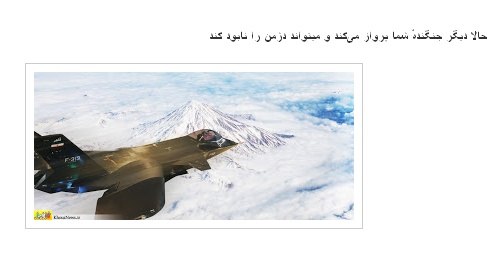
They released this photo as proof that screw you, Internet, the F-313 is so totally a functional, deadly and awesome-looking plane.

Soaring majestically over its enemies, or maybe just big a mountain.


I... I don't... sigh. Here, let me use another picture to sum up my reaction.

I call it "the Iranian salute."

The issues with this, ahem, "proof" are so obvious that this Arabic-language blog, harfhaye-nagofte-elham, sums them up perfectly even if you don't speak Arabic.


Yeah, Iran. Really? What is the mindset behind releasing a photo like this that takes essentially no expertise to undress? Do you think the rest of the world--literally, everyone connected to the Internet--is that dumb?

My guess is no. This is more meant for domestic consumption. Which in many ways is even more troubling. Iran has good universities that produce lots of well-trained scientists and academics. The country's leaders must think tremendously little of their population if they expect them to believe this clumsy "look at me!" stunt is actually reality.

As far as PR exercises go, this is an abject failure. The external audience can see through it and laugh. The domestic audience can see through it and wonder why their government thinks they're simpletons. And there's not even any point in talking about it as a legitimate weapons program.

In short: no matter how you look at it, the F-313 just doesn't fly.

Tuesday, February 5, 2013

What the opposite of stealth looks like

I can't believe I missed this: On Saturday, Iran rolled out what it says is an indigenous stealth fighter. And unlike other high-profile weapons it has announced, this one can be viewed from all angles:


The video includes a clip of the thing in the air, which I'll get to in a sec.

First, though, let's address the most obvious question: is the F-313 a threat?

It certainly looks stealthy, doesn't it? Beveled edges, air intakes on top of the fuselage, canted tailfins. These are indeed design elements that, when used correctly, do reduce an aircraft's radar signature. To wit:

The B-2's air intakes--and engines--are shielded from the ground.

The facets of the "Hopeless Diamond" bounced radar waves away from the reciever.

But here's the thing. The entire aircraft appears to have been designed by someone who just wanted to represent every whistle and bell of stealth technology they had seen in photographs. Up close, it's pretty obvious that we're looking at the equivalent of a practical special effect piece.

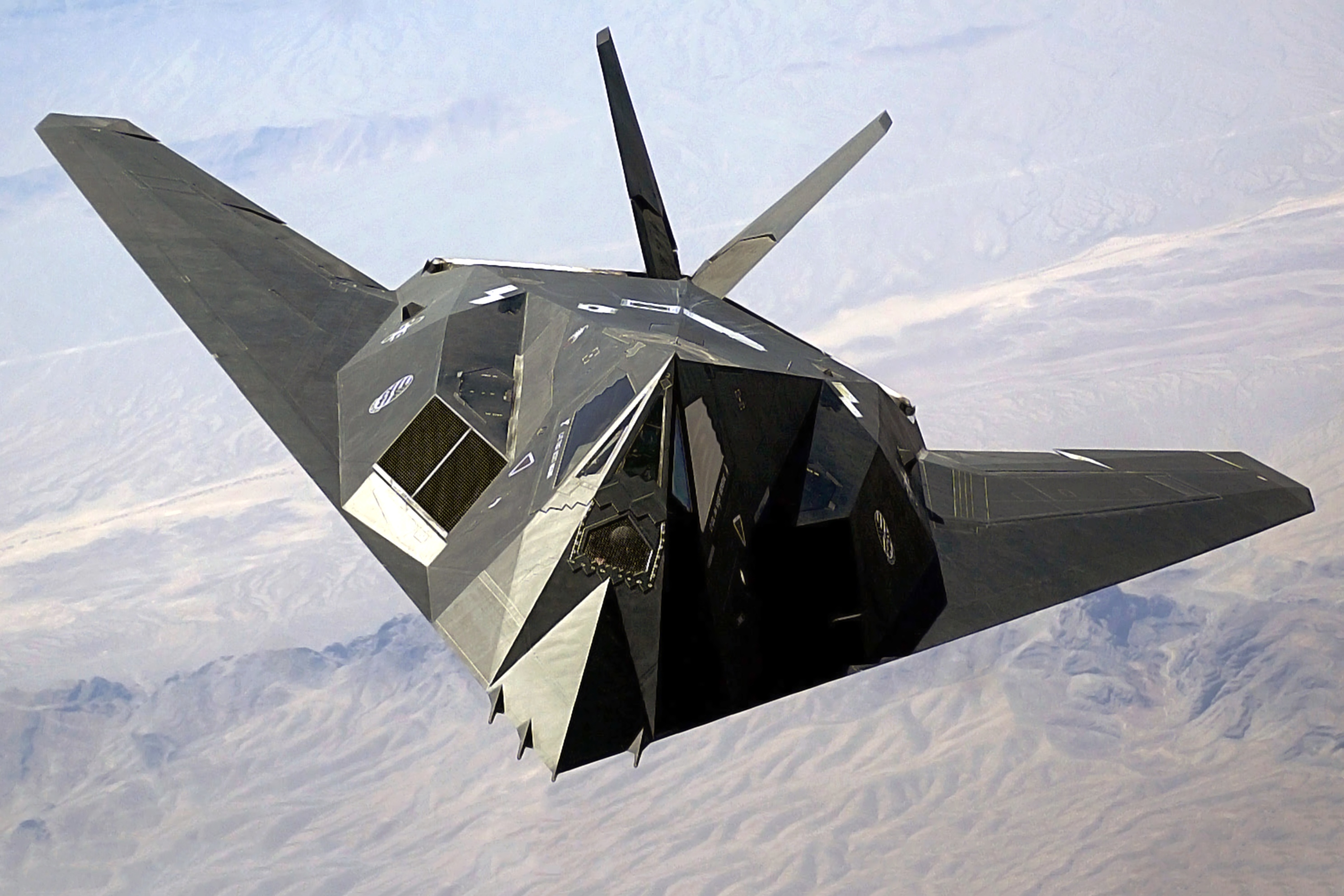
For instance, those above-wing intakes? As noted in the Aviationist, they are far too small to support a high-performance engine. They also appear to have been borrowed from pictures of an F-117.

Close...

... but no cigar.

The plane's tailpipe section is puzzling too. Although building stealthy nozzles can be difficult, the Iranians seem to have gotten around this issue by simply... not having a nozzle. That means either they are using a low-thrust engine without an afterburner (which would not require a variable-geometry nozzle); it's a rocket, ala the X-15; or there's no engine at all.


In any event, the section closely resembles that of the F-35...

Hot stuff.

... without, of course, the all-important bit in the middle.

Not so much.

Even just looking at basic details like the aircraft's skin show imperfections that at the very least are a sign of sloppy craftmanship, but more likely just reflect the fact that there are no stealthy materials or coatings involved here: just some type of skin stretched over a metal or wood frame.

Look at the way the light reflects off various surfaces; they're not smooth at all.

Also, the cockpit is tiny and filled with low-tech instrumentation.

There's no way I would fit in that thing.

And the list of parts obviously "stolen" from pictures or the internet goes on and on.

The wings? Check out the Boeing Bird of Prey demonstrator:

Formerly secret; always awesome-looking.

The vertical stabilizers? I smell F-22:

Tilted for practical reasons, but also pretty.

The canards (which are nearly as big as the main wings and, hilariously, don't seem to pivot)? How about the brand-new and mostly unproven J-20:

Neat-looking, but with problems.

In short, it has copied superficial features of prominent aircraft, tacked on a cockpit that would look at home in a Cessna Skyhawk, and mounted all of it on a frame that probably includes some balsa wood. Don't even get me started about that canopy made of scratched-up plexiglass.

And all of THAT doesn't even matter as much as the fact that the whole aircraft (listed here as, I think, being 16.4 meters long) isn't big enough to fit stuff you like to see in a fighter like, well, weapons. And avionics. And even usefully large fuel tanks. You get the idea.

But if it's actually flying, they obviously built something useful, right? If you watch the video above all the way through, you see some footage of what appears to be the F-313 zooming around the sky. The problem is, the footage also doesn't look completely real. The first frames of the video allow for some scale comparisons (because you can see the ground and people), and it makes the F-313 look pretty small. Like, "I'm a model" small. You can in fact buy jet-powered radio-controlled model kits of stealth aircraft online.

So unlike China, which appears to have done quite a bit in developing some new aircraft in-house, Iran has put together something that basically belongs on a movie set.

Then they made a big production out of introducing it to the world... and provided close-up photos and video that clearly show it to be at best an amateurish, large-scale mock-up (albeit one that already has its own Wikipedia page). That's an expensive sales job for a country with a struggling economy, and it's beyond doubtful that anyone is buying.

On the other hand, if your goal is to get the world to ignore your air force, then maybe this plane is stealthier than I'm giving it credit for.

Tuesday, January 29, 2013

The little engines that can't

The Chinese aviation industry has been busy lately. Two stealthy looking fighters made big headlines, although their capabilities are suspect.

Now the Y-20 transport aircraft has made its debut, and the Chinese military says it will "enhance its global power projection."

It's tough not to notice the similarities between the C-17 Globemaster III, the U.S. Air Force's workhorse transport aircraft, and the Y-20. The more cynical among us might suggest that the same Boeing blueprint is the basis for both--although the shared characteristics could just be a matter of two groups of engineers arriving at the same conclusions (which happened, for instance, with the Space Shuttle and its apparent doppelganger, the Buran).


C-17: Separated...


Y-20: ... at birth?

Anyway, graceful though the Y-20 may appear, it looks like it will be beset with many of the same issues that undercut the J-20 and J-31. Chief among those issues: the engines. You can build a spacious cargo hold, ingenious ramp design and robust wings, but without efficient engines, the power-projection abilities of a cargo aircraft are limited.

What's more, as defensetech.org notes, there is some doubt that China could have produced such a large airframe using mainly composite materials--a key factor in the C-17's long legs.
Chang also noted that the C-17’s long-range performance is possible because of the airplane’s composite materials, the manufacture of which the Chinese have struggled with to date.  And the Y-20 was likely to take at least another five years to enter operational service, he added.

So in the end, although another (literally) big project has (literally) gotten off the ground, the People's Liberation Army Air Force remains squarely behind the eight ball in terms of airlifting capability.

"Never start a land war in Asia," a wise man once said. This is dead-on in terms of China, which, thanks to geography and tremendous manpower, is not on anyone's list of places to invade. But despite all the talk of "strategic pivots" to face an "expansionist" China, the People's Liberation Army is unable to project much of its might far from home. The military cargo plane that can't fly from one end of China to the other without refueling is just the latest example.

Monday, January 28, 2013

The best defense....

In these heady days of McDonald's-dominated globalized economies, the idea of a world war seems far fetched. Resources, no matter how scarce, can always be traded for at a lower cost than mobilizing a military and doing some killin'. Conventional thinking is that small, "low-intensity" or "brush fire" conflicts will become more common even as large-scale confrontations become a thing of the past.

And it makes sense. Japan and China will posture for the fans back home about the national importance of some stupid islands, but in the end no one will pull a trigger... because even posturing carries economic consequences.

This is the way rational actors behave.

That leaves the other, crazier side of the coin to worry about. Places like North Korea, which by just about any standard seem to put somewhat random military goals above the welfare of their own people. Such "rogue states" are a major reason why the U.S. has poured billions of dollars into developing missile-defense systems of various kinds.

Some systems, like the one now deployed in Turkey, exist to shoot down shorter-range ballistic missiles that travel a few hundred miles and follow an unsophisticated ballistic trajectory. Thanks to math, they are easy to hit.

Other systems are designed to hit warheads in their "terminal" phase, which is to say after they are on their way down. This is tougher because not only are the warheads involved here generally traveling much faster, but they have to be completely destroyed or their explodey bits and pieces will continue on the same trajectory, landing more or less where they were aimed.


(Yes, that twisty maneuver at the beginning is deliberate.)


And finally, there's the toughest shot of all: the "mid-course" interception. Roughly put, this is the best time to blow up a missile, because it means it won't land where it is supposed to. It's also hard because it is incredibly high up--hundreds of miles--and involves tremendously high speeds.

The third one is probably most important if you're talking about dealing with serious threats from irrational actors. North Korea, for example, could use short-range missiles to hit Seoul, but would need an ICBM, perhaps modeled off their most recent successful rocket launch, to hit the United States.

And if you're shooting a missile that far, it's probably going to be a special delivery, i.e., nuclear, chemical or biological. Fun!

In terms of deterring people with huge arsenals, like Russia, anti-ballistic missile systems make little sense. Indeed, you could argue that they are not just a waste of money, but are destabilizing, because they offer one side the (false) belief that it could shoot first without suffering retaliation.

So again, that leaves the North Koreas of the world as the justification for developing these extremely tricky, extremely expensive systems.

It is on that note that we arrive at the punchline: China, North Korea's closest ally, just announced a "successful" test of a mid-course interception system.

China again carried out a land-based mid-course missile interception test within its territory Sunday.

Xinhua learned the news from the Information Bureau of China's Defense Ministry.

"The test has reached the preset goal," an official with the bureau said.

"The test is defensive in nature and targets no other country," he said.


For all the grumbling about U.S. interference in Asian affairs, it appears the continent's most powerful military is spending its money developing weapons to protect it not from a Western hegemony... but from its next-door neighbor.

Saturday, January 19, 2013

The Art of Old Guy Basketball, Part II

Good evening, dear readers. I write this to you from a chair, which is not in itself unusual, but it is a chair from which I will not easily rise. That's because for the first time since arriving in Hong Kong, I played ball.

Oh, yes.  The Parents of the Blog got me a basketball for Christmas. I had been in the market for one for a while; our digs in Hong Kong are basically surrounded by public sports facilities, including some nice basketball courts. Many a day I walked by, taunted by the pristine nets--not chains!--well-maintained backboards and playing surfaces that, as far as I could tell, appeared to be scrubbed weekly, if not daily.

Someone pays close enough attention to the courts that the trapezoidal "international" foul lane…

The geometry makes it more fair, or something.

… had been scrubbed out at some point and replaced with the NCAA standard free-throw lane. Not only that, but the NCAA three-point line, which was recently moved to 20 feet, 9 inches, was up to standard. And you could see where the old one was before the groundskeepers scrubbed it off.

How to use the NCAA three-point line.

Anyway, the point is, I had been wanting to get out and see how bad my shot had gotten since hooping it up in the Middle East. Today, I did it (after buying an air pump at Toys R US. Don't judge; the sporting goods store was "sold out" of pumps).

The result is, as I mentioned above, extremely sore knees. But I finally got a glimpse of what street basketball in Hong Kong means, at least in our little overplanned high-rise forest of a neighborhood. Several observations:

1) On the courts where I was playing, everyone wanted to be a guard.

2) No one played a ton of defense.

3) The average height was greater than that of the rest of Hong Kong, but still less than 6-foot-3, i.e., me.

That meant several things. Point (1) meant that I, a guy who somehow managed to be a post player in high school (second-most blocked shots in freshman history, holla!), had an advantage in not just height but know-how. Everyone was willing to give up position in the paint, no one seemed to see my patented, and by that I mean totally telegraphed, shoulder-fake coming, and I boxed the hell out of anything that moved.

Point (2) meant that when I did get away from the basket, I could square my shoulders, set my feet, not jump, and have a clean look at the hoop. It also meant that by playing any defense AT ALL, I could affect the game. This type of nominal guarding saved me the embarrassment of wheezing to a halt on a court full of young whippersnappers.

Point (3) meant the obvious--even my 36-year-old, bad-kneed self could get away with not jumping a whole lot and still getting rebounds, blocking shots, and so on.

In short: It was the perfect recipe for a game of Old Guy Basketball. I didn't dribble much. I passed a lot. I didn't shoot more than a couple of times beyond three feet. I was probably really annoying to anyone chasing a rebound under the basket.

And my team won.

I will take comfort in that as I ice my knees.