I have a confession to make. When I was a teenager--despite an active social life, participation in sports, a healthy appreciation for live music and shenaniganry--I played role-playing games with my friends. (all of whom, its worth noting, have grown up to be productive members of society, with families and everything)
Mostly it was an excuse to stay up late, swear and tell stories in which our characters were world-saving badasses. And who doesn't enjoy a little badassery? Another game we played a lot wasn't role-playing at all, but a board game sheer mayhem and destruction featuring walking tanks.
But all of it was fun. And extremely informal. And not taken seriously.
In other words, 180 degrees from this:
Yeah. Not sure what to say here except that A) It looks like a well-made documentary and B) At least the subjects are getting some fresh air. I'm not judging, it looks like they're having a lot of fun, and that's good, but... I dunno. It is my opinion that some things in life, like games, aren't meant to be taken so seriously.
That might explain why I'm so terrible at cribbage. Average at backgammon, though--thanks, Pete!
Wednesday, April 23, 2008


Thursday, April 17, 2008
A man, a plan, a canal, a camera, and no palindrome
Yes: Panama. What follows is a brief pictorial of the Gang of Seven's travels through the world's most famous skinny country. It spans 12 days, four different states, two oceans, one canal, three puddle-jumper flights and three bus rides. Interestingly, I didn't ride a single elevator the entire time. Hmmm.
Anyway, let's get to it.
When we were in Panama City--at the beginning and end of the trip--we stayed in an older section of the city called Casco Viejo. There was a lot of history piled there, much of it crumbling, some of it restored or in the process of restoration. Narrow streets, cobblestones, ornate architecture and crumbling facades were the rule.
 All that remained of this church--more than three centuries old--were its front walls and a partially enclosed courtyard. Note the tree growing from the top.
 Four of the Gang of Seven in one of our Panama City apartments doing what we did every night: Try to take over the world. Or, alternatively, drink huge amounts of Balboa lager.
 There was a school across the street about a half-block from our apartments, La Escuela de Simon Bolivar. The building is a former meeting hall where the South American revolutionary staged rallies. One afternoon the city's power went out and the kids--hot and without anything to do--poked their heads out the window.
 Across from the school was the Parque Bolivar, which included a giant statue of Bolivar and, in this picture, two of the Gang of Seven playing backgammon. The square had restaurants and bars on two sides, apartments on one and a government ministry building on the other.
 A few blocks away from the Parque Bolivar was a former prison used, hundreds of years ago, to hold political prisoners. Now it's been redeveloped into a museum and restaurant. On its roof is a walkway from which you can look out at the harbor. That's where this Kuna (an indigenous tribe) woman is standing, dressed in traditional clothes. This is the only picture of a Kuna you'll see here, as the folks in Kuna Yala discourage photography of people.
 Another example of the semi-ruins in Casco Viejo. This is an old hotel--who knows how old. In the background is downtown Panama City.
 Beneath the ruins of the hotel was this arched breezeway thingy. Hard to tell what it was used for... there appeared to be some doorways that were blocked by debris. The person in the far background is Friend of the Blog and Taker of the Author's Photo Christine.
 What would a trip to Panama be without a visit to the canal? This is the Miraflores locks, in which ships enter from the Pacific side heading toward Lake Gaitun and eventually the Caribbean. The Gaitun side is on the right here--the lake itself is considerably higher than sea level. The system is entirely gravity-operated; there are no pumps.
 Next we went to Kuna Yala (literally "Kuna Mountains" in the native language), or San Blas, an indigenous autonomous zone in the northeastern part of the country. It's an archipelago, and all the residents live on islands of varying sizes. The airstrip we flew into, however, is on the mainland. Here you see a DeHavilland Twin Otter landing on the strip, hacked from the jungle and marked by sticks topped with white plastic bottles.
 From the airstrip we were taken by 15-foot motorboat to the island where we would spend the next few days. This is the dock where we landed. In the background is one of the two uninhabited nearby islands. Beyond them is the open Caribbean, crashing against a massive reef system.
 This is where we slept: Three thatched huts set over the shallow water. They had gravity-fed plumbing and chemical toilets, which was nice. A boat brought in two drums of potable water each day. This photo also shows how small the island, called Dad Ibe, was: Maybe 2,500 square feet. More palm trees than people.
 This is the open-walled hut at the other end of the island in which we ate. Three Kuna came in by motorboat every morning to do the cooking.
 For a challenge, we swam to the nearest uninhabited island. The head on the left is me.
 This is the shoreline of a Kuna village we visited on a much larger island.
 As you might imagine, the Kuna, living on islands and all, are quite used to traveling by boat. Some are fiberglass, some are handmade, some are powered by motors, some by sail. All are piloted expertly in seas calm and heavy.
 After two plane rides and one eight-hour wait in Panama City, we arrived in Boquete, in the northwestern part of the country. It was mountainous, a big change from where we'd been before, and its distinguishing feature was a giant dormant volcano called Baru. We crammed a bunch of stuff into Boquete: A visit to a coffee plantation, a zipline trip through the jungle canopy, and a hike through the jungle. That's what we're doing here, hiking through the jungle near Baru, headed toward a waterfall buried in the dense vegetation.
 The aforementioned waterfall. It probably dropped 300 or 400 feet.
 From Boquete we got on this bus to head to our next destination, El Valle de Anton. You might notice that the bus had a name: Golden Boy. Most of the buses we saw in Panama had names like this. In Panama City, it was even better. The intra-city bus system was entirely private, with individual operators owning each bus, usually a retired school bus. The buses were tricked out like hot rods and all had Anglo women's names, like Sylvia Marie, Nicole Kristin, and so on. Although I did see one named Marc Antony. Seriously.
 Because there were seven of us and we were remarkably polite, the bus agreed to drop us not at its scheduled stop, but at Las Uvas, the village closest to El Valle de Anton. Then we had to wait for a bit for another bus to swing by and haul us the rest of the way. Here Friend of the Blog Pete rests by the bus stop in his stlyish-yet-practical campesino hat.
 El Valle is exactly what it says: A valley. Specifically, a circular valley that happens to be the floor of an extinct, 5-kilometer-diameter volcano. It's beautiful and has some grand old hotels frequented by vacationing Panamanians. The oldest and grandest, sadly, was being renovated whilst we were there. This is what was left: A grand facade, a grand fireplace and a grand mountain.
 El Valle is so beautiful that even Atlas and Balboa can live side-by-side in harmony.
 And finally, we returned to Panama City and the uneven streets of Casco Viejo.
Thus concludes A Pictorial Trip Through Several Parts of Panama. I hope you enjoyed it. And I know I don't have to tell you what the soundtrack should be.
Wednesday, April 16, 2008
Close encounters of the Doyle kind
It's official: I (and "From the Depths") will be appearing all day at the Kansas City Literary Festival on May 17 in the beautiful if somewhat over-policed Country Club Plaza. I'll be sitting at the Missouri Center for the Book's table, and because that's not a commercial enterprise, you can buy a copy at the Rainy Day Books tent.
Here's the festival's Web site: http://www.kansascitylitfest.org/
I'll also be doing a signing at the Borders in Lawrence, Kan., home of the WORLD CHAMPION KANSAS JAYHAWKS, on May 19 at 7 p.m. The store's at 7th and New Hampshire, and rumors that the author will visit a local tavern afterward are almost certainly true.
More events that weekend are in the works. Watch this space for details. But be sure to blink.
Wednesday, April 9, 2008
How to stay cool near the equator
There's a one-word answer: Beer. Well, more accurately, cold lager.
In Panama, you have approximately four local options.
 Balboa. Like all the beer we had there, it's best when ice cold. But it still has a nice lager flavor to it; not hoppy and fairly dry. We also were told it was the bourgeoisie beer among Panamanians. Which brings us to the U.S. beer comparison: Sam Adams. Like Balboa, Sam Adams is considered to be slightly above other mass-produced beers. And Like Balboa (the person), Sam Adams (the person) was partially responsible for the founding of a country. So there you go.
 Next, Cerveza Panama. This is a tough one. It's just an everyday working-class lager, best when served extremely cold, pedestrian when it's room temperature. Rolling Rock has been suggested as an American analog, or maybe Michelob. It's a blue-collar beer for blue-collar Panamanians, which is pretty much everyone.
 Atlas. Bleh. It tastes like... nothing. Water with a coppery smell. As one discerning taster put it, "it's like drinking a penny!" I wouldn't go that far, but it's certainly not like drinking anything good. And like its American counterpart, Budweiser, it's ubiquitous--available everywhere and on billboards wherever you look. My advice would be to buy water instead. It's cheaper.
 And finally, Soberana. Other than the obvious hilarity of naming a beer after a teetotaling chick, it's not bad. It's cheap, probably the cheapest of the four. It's definitely better than Atlas, and has a little bit of added value for it. So I think we can draw a nice parallel between Ms. Ana and PBR/Old Style. A decent, cold beer with the added value (and street cred) of being cheap as hell.
There you have it. A guide to Panamanian beer. Although, looking back, I could have shortened this to one sentence: Drink Balboa, avoid Atlas. Cheers!
In Panama, you have approximately four local options.
 Balboa. Like all the beer we had there, it's best when ice cold. But it still has a nice lager flavor to it; not hoppy and fairly dry. We also were told it was the bourgeoisie beer among Panamanians. Which brings us to the U.S. beer comparison: Sam Adams. Like Balboa, Sam Adams is considered to be slightly above other mass-produced beers. And Like Balboa (the person), Sam Adams (the person) was partially responsible for the founding of a country. So there you go.
 Next, Cerveza Panama. This is a tough one. It's just an everyday working-class lager, best when served extremely cold, pedestrian when it's room temperature. Rolling Rock has been suggested as an American analog, or maybe Michelob. It's a blue-collar beer for blue-collar Panamanians, which is pretty much everyone.
 Atlas. Bleh. It tastes like... nothing. Water with a coppery smell. As one discerning taster put it, "it's like drinking a penny!" I wouldn't go that far, but it's certainly not like drinking anything good. And like its American counterpart, Budweiser, it's ubiquitous--available everywhere and on billboards wherever you look. My advice would be to buy water instead. It's cheaper.
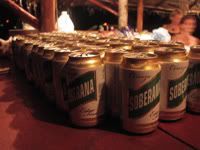 And finally, Soberana. Other than the obvious hilarity of naming a beer after a teetotaling chick, it's not bad. It's cheap, probably the cheapest of the four. It's definitely better than Atlas, and has a little bit of added value for it. So I think we can draw a nice parallel between Ms. Ana and PBR/Old Style. A decent, cold beer with the added value (and street cred) of being cheap as hell.
There you have it. A guide to Panamanian beer. Although, looking back, I could have shortened this to one sentence: Drink Balboa, avoid Atlas. Cheers!
Welcome back, Doyle
Yes, back in my native land, where the prairie grasses grow higher than a plow horse's eye and proud fast-food institutions dot the landscape and every spring a national champion of college basketball is named.
This year, it was the Kansas Jayhawks.

And so I, a Kansas alumnus, feel duly and warmly welcomed home. Coming soon: A comparison of U.S. and Panamanian lagers!
This year, it was the Kansas Jayhawks.

And so I, a Kansas alumnus, feel duly and warmly welcomed home. Coming soon: A comparison of U.S. and Panamanian lagers!
Monday, March 24, 2008
My name is David Lee Roth and I approve of this vacation
No, I'm not going to rehab. I'm going to...
 PANAMA!
I plan on taking lots of pictures of monkeys, buying a nifty hat and avoiding getting bitten by anything too poisonous. You'll get a full accounting after I return, although because I'm using one of them un-fancy non-digital cameras, photos might take a bit longer.
Until then, hasta luego!
Saturday, March 22, 2008
Thrilled
I just got word that I have something in common with George Clooney, Daniel Day-Lewis and that guy who played Chigurh in "No Country for Old Men." A nomination.
Specifically, a nomination for best debut novel of 2008 from the International Thriller Writers.
Specifically, a nomination for best debut novel of 2008 from the International Thriller Writers.
BEST FIRST NOVEL 2008
Interred With Their Bones by Jennifer Lee Carrell (Dutton)
Big City, Bad Blood by Sean Chercover (William Morrow)
From the Depths by Gerry Doyle (McBook Press)
Volk's Game by Brent Ghelfi (Henry Holt and Co.)
Heart-Shaped Box by Joe Hill (William Morrow)
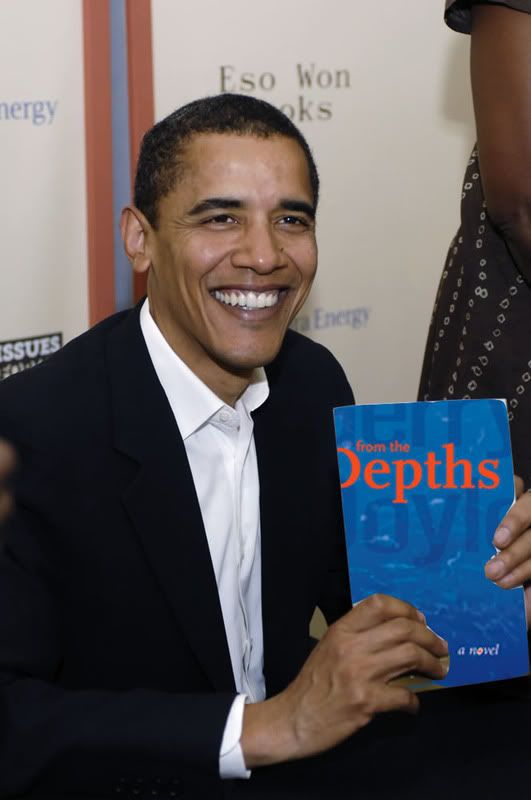
Possible red carpet guest Barack Obama.
No, you can't stuff the ballot box. A panel of judges will make the final decision. And the judges are writers, who, as you know, want for nothing and are unbribeable. (by the way, do not under any circumstances take the preceding link seriously)
But it's still pretty cool. The only question is, should I go with the De La Renta tuxedo, or Armani?
Subscribe to:
Posts (Atom)