Showing posts with label Noise. Show all posts

Thursday, September 17, 2020

The best news on Earth is not on Earth

This year has been one of the worst, and most bizarre, in decades. Certainly of my lifetime. Democracy is crumbling, fascism seems ascendant, climate change is causing catastrophes and of course there's the pandemic, which... well, we all know how bad that is.

Maybe that's why the news that leaked--and then gushed--out earlier this week felt so important. Signs of life on Venus! Right next door! Closer than Mars, even! The details of the announcement, that scientists had found in Venus' atmosphere phosphine, a gas that is only naturally produced by organisms, made it all the more exciting. They had worked hard to rule out other explanations, and made their observations at different times using different equipment. The most likely explanation for what they were seeing, they said, was life.

Venus. Not pictured: atmospheric microbes.

When methane was found on Mars a few years ago, it felt more interesting than exciting. Like phosphine, methane is unstable and most often is produced by living organisms. The amounts detected on Mars shouldn't exist unless it is being continually produced, or released from deep under the planet's surface. The methane still hasn't been explained (or biological origins ruled out) but I guess that caveat felt pretty big.

With the Venus news, the chances that it wasn't a sign of life seem much smaller. It would need to be an observation error, or the phosphine would have to be caused by some undiscovered natural process.

That's cool on its own. But what makes it even more moving, for lack of a better word, is what it says about the universe. Venus is inhospitable in every sense. Heat, pressure, corrosive substances. Like the song says, if you can make it there, you can make it anywhere. Life on Venus, even microorganisms, sure seems to imply that it is likely to exist on some of the other billions of planets in just our galaxy.

Handy neighborhood map.

So while we're wallowing through 2020, it's nice to think that at least we might not be doing it alone.

Saturday, July 4, 2020

Happy America Day!

This is probably the weirdest 4th of July in my lifetime, but even so... hard to beat the Muppets.


Here's to everything being better, and more normal, next year. But still with Muppets.

Wednesday, March 18, 2020

Things are weird

I've said this, in different ways, to many people in recent days. And it's true: this is an unprecedentedly bizarre time.

I'm watching most everything unfold from some distance, tucked away in Singapore, whose authoritarianism is problematic in every circumstance except, it seems, a viral pandemic. Things are mostly normal here! Very few masks, very few disruptions, very few cases of SARS-CoV-2. And that makes it even more bizarre to see everything unravel back home.

It's all so worrying. By now, enough scientists have studied the virus that they can confidently project its effects on the global population. There's nothing good about what they found. Doing nothing is catastrophic. Mitigation will still lead to great loss of life. Suppression will have wide-ranging societal and economic effects. No easy answers. You can read it here.

The fact that so much of the catastrophe is occurring in slow motion makes it all the more surreal. This isn't a meteor impact or a nuclear war. And, tragically, if governments--I'm looking at you, "it's a hoax" White House--had taken it seriously sooner (and not dismantled key elements of government that deal with situations like this) we might not be facing such stark choices. But here we are, facing stark choices.

In America, at least, the social safety net is made out of tissue paper. People who lose their jobs will fall back on almost nothing. They will have no access to free health care. That suffering was also avoidable.

Staying home, washing hands, not touching our faces--these things will all help limit the damage. If you aren't sick (with anything), please don't waste a mask that someone on the front lines could actually use. Be kind. Don't be racist. Don't say "I'm an American, I can do what I want." Definitely don't assume that because you're young, you're going to be fine. There are millions of people older than you with perfectly good lives who want to continue living them; walking around with an "I'm bulletproof" attitude will help get them killed.

Until there is a vaccine, this is just going to be how it is. Eventually the dust will settle. I don't think life will get back to normal, not in any real sense. But even though the other side of this looks far away, it will come.

See you there.


Friday, July 19, 2019

Airplanes! Tom Cruise! Footage!

So this is the best trivial thing that's happened in a year of non-trivial bad things: Top Gun 2 is upon us. And it has airplanes (plus, somehow, shirtless volleyball again).


A few observations:

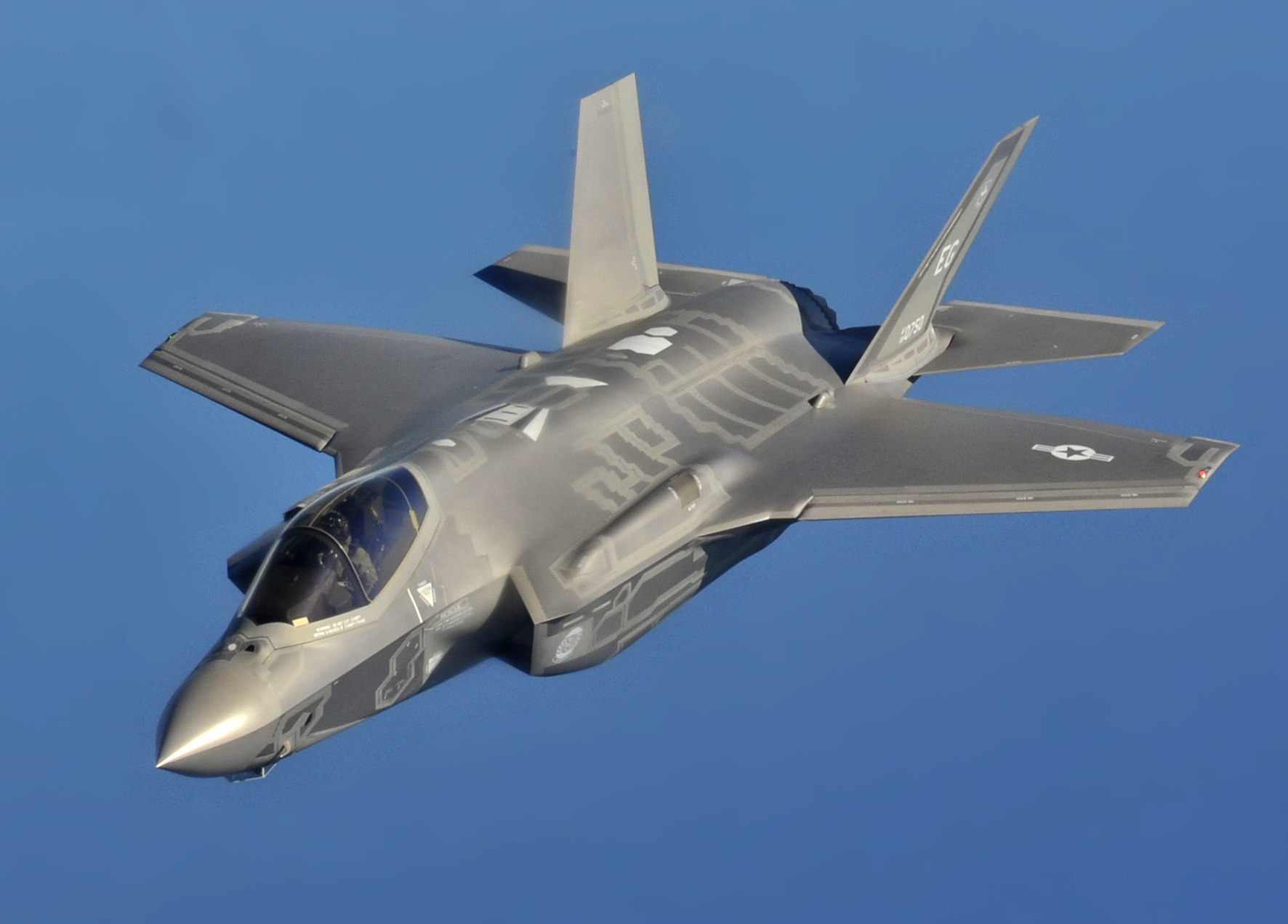
-I was surprised at first that the Department of Defense didn't insist that the movie use the F-35 instead of the F-18. If there's any aircraft in need of good P.R., it's the F-35.

Image result for f-35
The poor, misunderstood, Lightning II.

But then it hit me: there's no two-seat version of the F-35, which means they can't create any footage of Tom Cruise in an actual jet. So the Super Hornet won by default, the most glorious way of winning.

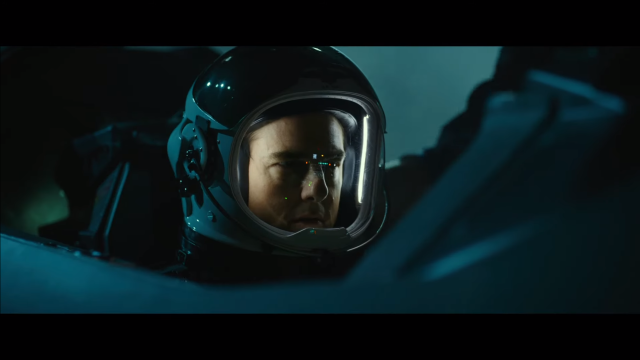
-Why is Maverick wearing a pressure suit?

Image result for maverick pressure suit
Under pressure.

This is different from a regular flight suit in that, as you might expect, it's pressurized. That allows pilots to work at extremely high altitudes where the air pressure is essentially meaningless in terms of breathability. But the only aircraft the U.S. flies right now that requires that type of gear is the U-2, which flies (without Bono) at altitudes up to 85,000 feet. So what's the deal, is Mav flying a Cold War-era spy plane at some point?

-Maverick is a terminal captain. In the exchange with Ed Harris (Tom Skerritt is 85, which is even by Hollywood standards I guess too old to play an active duty Navy officer), we learn that Mav will never get promoted--the rank of captain is where he will end his career. I guess they had to build that in somehow, otherwise how exciting would a movie about "Admiral Pete Mitchell" be?

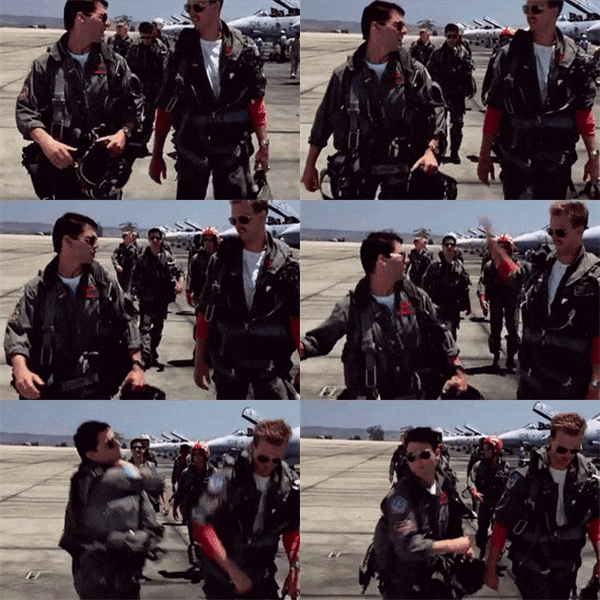
Anyway, I'm sure it will be a bad movie but I'm equally sure I will see it and react exactly like this as I walk out of the theater:


I feel the need....

Thursday, January 10, 2019

Turn up the radio

In recent years, astronomers have discovered new faraway planets, gotten close looks at distant objects like asteroids and comets, and driven lots of robots around Mars.

All of this is in service of exploring the physical universe and learning more about why things are the way they are, basically. That's exciting! But there is also this sort of deeper human need to find out whether we're all there is in terms of intelligent life. Scientists and philosophers argue about the odds--on the one hand, they're infinitesimal because shouldn't we have seen something by now given how old the universe is? On the other hand, they're quite good because the universe is as vast as it is old... that's a lot of planets.

Anyhoo, there's not much evidence to go on in that regard. There's the WOW! signal, which no one ever really figured out. And lately there have been "fast radio bursts," which are also mostly unexplained. This week, more of those bursts were announced, including an unprecedented repeating burst.

“When these bursts happen once only, it’s really hard to figure out what created them,” Cherry Ng, a radio astronomer at the University of Toronto and lead author on the paper about the repeating FRB, tells The Verge. “Now we’re showing, no, at least one other repeats.”

I've always felt like this is the way we'd get evidence of "other life out there"--something pretty inscrutable and outwardly mundane, as opposed to in the movies where detailed messages or even space ships arrive.

what will the aliens' morning drive zoo crews sound like?

To be clear, these bursts are almost certainly caused by natural (if distant) phenomena. That doesn't make them any less fascinating... it's a new physical mystery to unravel.

But it's sure fun to think about the tiny chance they're more than that.

It's been a rough few years for this planet, and finding life on another one would somehow make that feel more bearable.

Monday, December 31, 2018

Happy New Year

It hit me last week that the last two posts on this blog were tradition--Fourth of July Muppets and the Pogues on Christmas Eve. Not much in between. And by "not much," mean nothing.

Part of that is because I'm dealing with a lot more words at work than I ever have before. Part of that is that the world outside work is crazier than it has ever been. I don't think that's an exaggeration. I've been alive for [REDACTED] years, but I can safely say that even in the tense closing years of the Cold War I never felt like everything was teetering so close to the edge.

We also moved to a new city-state with a new imaginary mascot, the merlion:

RAaaarrgurgle

Singapore presents its own unique challenges, such as schools with Cordon Bleu-trained chefs and a price tag to match, and an equatorial sun that will burn the health right out of your skin.

But for all that, there is much to be thankful for in 2018. Health and happiness. Good food. Loving family. A Chiefs quarterback that can do this...


... and is only like 19 years old.

No one can say what 2019 will bring. I suspect there will be many moments of global instability and wackiness, and if the two years since November 2016 have taught us anything, it's that expecting things to return to normalcy and stability on their own is... not a great plan.

So here's to hope, and action, and for good things in the year ahead.

Monday, December 24, 2018

It’s Christmas Eve, babe

It’s been a weird year... who knows what the boys in the NYPD choir are singing. But I hope, earnestly, that it ends on a good note for you. Sometimes that’s all we can ask.

Here’s to 2019, dear reader.


Monday, March 26, 2018

Rock Chalk

It's been a while since I have written about basketball. This is mostly, I think, because game time (usually in the early morning hours in Singapore) is often *exactly* the same as toddler time (usually the early morning hours anywhere). Don't let anyone tell you I'm indoctrinating my kids; I could easily have set them down in front of the TV to watch some KU hoops, but I've been good.

This year's Kansas team has been... interesting. I've woken up to see some really bizarre scenarios: three home losses! A five-star recruit quitting to go play in Europe! A near-total absence of depth! But at the same time, they have beaten more top-quality teams than any other program this season. There's something about the team that, when it works, works really well. They won the Big 12 regular season championship and the conference tournament.

The first trophy of, one hopes, many.

And this morning, they went to the Final Four for the first time since 2012.

I watched most of the second half on my laptop, in the dark, while I ate my cereal. Then suddenly it was overtime, and I was late for work, and I "watched" the last five minutes by getting score updates on my phone.

And they won. They beat Duke in what may have been the best heavyweight showdown of the tournament.


Basketball is fun, and a nice distraction from all the other craziness in the world. It would be an even nicer distraction if the Jayhawks, just as they did the last time they were in San Antonio, won their last two games.

Friday, February 9, 2018

Highway to the Nostalgia Zone

When I was a kid, there was one weekend every summer I looked forward to more than any other.

It wasn't the Fourth of July. It wasn't a birthday. It wasn't even the last day of school.

It was Operation Handshake.

What was Operation Handshake? Glad you asked (and even if you hadn't, I would have explained anyway). It was, at the time, the largest airshow in the United States, attracting about 500,000 visitors over two days. And man, what a show.

I remember seeing one of the first F-15s, back when they were still painted light blue, do a max-performance takeoff into the vertical. I saw an F-117 there for the first time, and a B-2. The airbase where it was held, Richards-Gebaur, was home to a squadron of A-10s, and they never disappointed with an appropriately over-the-top ground attack demo featuring enough pyrotechnics to make Michael Bay blush. My dad was my wingman for most of these, and I have many fond memories of wandering through all the wings and kerosene fumes with him.

I was most definitely in the crowd for this one.

The base closed in the '90s and the airshows stopped around the same time. I haven't been to one since.

Until this week.

I was at the Singapore Airshow, which is more of a trade event than a public relations spectacle, as part of my job. I had a lot of fun and helped with some interesting stories. I even was asked to look directly into the sun and ad-lib an interview about Chinese drones. Yes, I know "Israeli" is not a country. I only got one take, OK?

It was, obviously, a much different experience than the airshows of my childhood. For one, there were weapons being sold everywhere, including this lovely dessert case of 40mm grenades.

Fun for the whole family!

For another, I was working, which meant I didn't get to gawk at the airplanes as much as I'd like. The most common backdrop for my airshow experience was the Media Room, Brought to You By Pratt and Whitney:

There was free food and coffee.

And for a third, Operation Handshake was, even in its later years, an American affair. There were certainly no aircraft from Cold War adversaries. But at the Singapore Airshow, you could watch a Su-30MKM do its thing:

Thrust vectoring makes for great flight demos.

... or a Saab Gripen:

Small, fast, maneuverable and Swedish.

There were also aircraft on display that simply didn't exist when I was younger, like:

The F-22 Raptor.

The F-35 Lightning II.

The RQ-4 Global Hawk.

The F/A-18E/F Super Hornet (although its smaller, older brother, the F/A-18 was around back then).

The WL-2 Wing Loong II, a Chinese strike drone.

The entire suite of Russia's United Aircraft Corporation fighter aircraft, in model form or otherwise.

... among many other things. I got to nerd out, I got to be professional, I got to see a lot of interesting hardware and drink some remarkably bad coffee. Most of the time I was in air conditioning, which is also a big change from the airshows of my youth.

My enjoyment of all things flight-related hasn't changed. The brief bits of the Singapore Airshow where I got to just stand and watch planes in the air brought back a lot of great memories. And maybe, just maybe, I can take my dad to the next one... or take my daughter (but I need to be sure to keep her away from the grenades).

Sunday, December 31, 2017

Happy New Year

I think for a lot of people, 2017 was a year that belongs in the rearview mirror. And it would be easy to spend this post listing the reasons why. In fact, I had written a couple of sentences doing just that before I caught myself.

Starting a new year isn't about looking at all the bad things from the previous you want to avoid in the next one. It's about hope. About a clean sheet and a brand new indelible marker to write with.

Definitely not visible from my window.

Sitting here in a serviced apartment in rainy Singapore, two kids fast asleep and a hectic December behind us, it's hard not to feel like we are poised for a big transition. Temporary housing will give way to a permanent home; we will get to know this city better (why are all the nearby playgrounds closed right now? Don't they know we have restless kids?) and forge ahead. I'll start a new job that will mean days of playtime with the kids and family lunches are back to being weekends-only treats.

All that is certain. I don't need to hope for it; it will happen.

So do I want out of the next year?

It's not hard. I want my family to be healthy, happy and safe. And I want 2018 to exceed 2017 in every way that it can. Is that boring? Maybe. But I won't be disappointed if those hopes are realized.

No matter how you feel about 2017, and no matter where you are or how you're celebrating (I will spare you the details of New Year's Eve: Corporate Housing Edition), I hope your hopes are realized too.

Here's to a bright, new year.

*edited to remove the artifacts of writing while recovering from 2017’s parting gift: a family-wide stomach bug.

Saturday, December 9, 2017

Revenge of the Return of the Misc Box, Part II: The Boxening

Well, readers, I'm sure you're just as aware as I am that it has been a long time since we've exchanged electrons here on the blog. Like a long time. As usual, I will offer no excuses other than: life has become busier than usual.

Sure, Gerry, you may say. But that's true of all of us out here in the world, watching American democracy teeter and Hollywood greenlight remakes of movies that were great the first time around.

And you're right. We're all busy in our own way.

My particular way of being busy these days is another international move.

Mrs. Blog and I, now joined by Little and Littler Blog, as I guess I'm calling them, are moving to Singapore. And I have a new job, with another global news organization. New climate, new restaurants, new weird-but-iconic statues.

Weird-but-iconic merlion.

It's a whirlwind, moving a family. A real maelstrom of stress, planning and preparation. All you can do is keep putting one foot in front of the other, logistically and mentally speaking, until you're at your new home. At least that's the theory. We haven't arrived at that home yet, so I can't say for sure.

An artifact of previous international moves has been the existence, at the end of a day of packing up a home, of a catchall box. It's not full of one type of thing (like glasses) or even stuff that all goes in the same room (like the kitchen). No, it's a Misc Box that holds stuff you want to take with you but isn't easily categorized.

This time around, it doesn't look like we'll have one of those. That's partly because Mrs. Blog is an expert at organizing, and partly because this move will be the best supported in terms of relocation services. I won't go into the boring details, but it does appear that everything--regardless of categorization--will be neatly packed away, only to rematerialize in our new Singapore pad.

Instead there's a mental Misc Box. We've been here six years--my longest stretch in anyplace that's not Chicago or Kansas City. We have roots and friends and two little kids who were born here. What the movers can't take, but what I'm bringing with me, are those things. Those relationships, memories and experiences--good and bad--we found in Hong Kong. They'll always be with me, even if they defy categorization.

And so off we go. Soon we'll hop on an airplane, shake the dust of the 'Kong from our shoes, and embrace the future (which may or may not be devoid of chewing gum).

Hong Kong hasn't been perfect. But it's been home.

Sic transit gloria mundi.

Or as they say in Hong Kong, "Bye bye!"

Thursday, July 13, 2017

Just like old times

Frank Mason III was fun to watch in college. Not just because he's a Jayhawk (which is awesome) but because he had an uncanny ability, maybe more so than any player since Jacque Vaughn, to take the tiniest crack in a defense and break the whole thing down for a scoring opportunity. It looked a little something like this:


Now he has been drafted--by Sacramento, in the second round--and is trying to play his way into a guaranteed contract in summer league games. A friend posted this clip of highlights from his latest game, and I have to say... it looks like he's doing the same sort of stuff as a pro that he did in college. It's uncanny:


I've never been a huge fan of the NBA, but if Mason sticks, that might change. He's that fun to watch.

Tuesday, November 8, 2016

Historic elections

No matter how things go on Nov. 8 in the U.S., the outcome will be a big deal. Either we'll have the first female president, or the first authoritarian; in either event, there is no putting the genie back in the bottle.

As we head toward the vote count, I remember the first "big deal" election I was a part of: 2000, Bush vs. Gore. I was working in Florida, so really about as close to a front-row seat as you could ask. But would you actually want a front-row seat? Here's how my day went down.

At work by 1:30 p.m. That's because our first edition closed at 3:30 p.m. (The St. Petersburg Times basically invented aggressive zoning), not because of any planning for electoral craziness.

Of course as the day went on, electoral craziness materialized. The race was tied! Florida's electoral votes would decide the presidency! But there was a wrinkle: no one knew exactly who had won Florida. Before the first statewide edition closed, however, the networks all called the state for Gore. Whew. Front-page headline could announce his victory, right?

You know how this goes. Those calls were based on exit polls, which turned out to be juuuust a bit outside. The state was anyone's to win, and the front page was ripped up for the final edition.

More profanity-focused options were discarded, apparently.


By this time, back in the days where continuous online coverage was a rarity, our work was more or less done. There would not be any more news before the presses rolled again that night. Off to an election night party at the house of a Co-Worker of the Blog!

Except... it was less of a party and more of an extremely boozy cable news watch marathon. None of us had seen anything like this. That feeling didn't change as the night went on. This was more than a close race, it was a total mystery, and as young journalists I think we were expecting someone, somewhere, to come up with an answer while we watched. That didn't happen.

And when I woke up the next morning, fully clothed, on my couch (OK, I was 22, it was a futon) at home the next morning with MSNBC still on, I was no closer to knowing what was going on than I was the night before, although the size of my headache suggested something terrible had happened. There was also an inexplicable shoeprint--my shoe, fortunately--about 7 feet up on the inside of my front door.

The next few months, well, you know how the story unfolded. Vote counting went on for weeks, chads were hung, court cases were heard, and eventually George W. Bush was officially the president.

It was all literally unprecedented. All of it. And Election Night 2000 remains a singular event in my career and in my memory.

This time around, Election Night in America will be Election Morning in Hong Kong. If there's any sweating out of results, it will happen at an inconvenient time for drinking. Let's hope there's no need for anything but a sigh of relief and removing the fivethirtyeight.com bookmark from our browser.

Until 2020.

Tuesday, October 4, 2016

Information isn't what it used to be

Oh, hello, gentle reader. I didn't see you standing there. Please, come in, sit, make yourself comfortable. It's been a while, I know.

Since my last post, the B-21 has gotten a name, the Raider, which narrowly beat out Nukey McMeltface, I'm told. The 2016 presidential election is well under way. And the Blog Family has grown by one.

Look at that paragraph. The three items there are not equal in value--at least not to me!--but are presented as though they do.

And this is what has been driving me nuts about 2016. I'm not the first person to spill ink, real or electronic, on this and I'm confident I won't be the last. But the fact that statements are more and more being treated as equally true regardless of source is a real, creeping problem with public discourse. "I read it on Twitter" should never have the same weight as "I read it in the Wall Street Journal" and certainly not "I saw it myself." Opinions aren't facts. Innuendo isn't argument.

This isn't limited to fallible humans. Today, a Google search will get you this result:

No, Google. Bad Google.

Happily, a Snopes link is among the top results, but c'mon, Google... that's not news. It's, put charitably, rumor and speculation. (Russia Today is a propaganda arm of the Russian government; True Pundit is a conspiracy website.) A more cynical person might call it outright disinformation. The most cynical person might say this is a result of how we are all subtly being encouraged to only treat as "fact" things that align with our ideology.

So look. All I'm saying is that all information is not created equally. Fact is not subjective. There is such a thing as getting it right, and the *best* sources of information will admit their mistakes.


But please. Don't just take my word for it.

Monday, February 29, 2016

Meet the new stealth bomber, (not quite) the same as the old stealth bomber

Let's talk about the B-21, a.k.a. the Stealth Aircraft Formerly Known as the LRS-B.

LRS-B, of course, was a somewhat tortured initialism for Long-Range Strike Bomber, with a hyphen thrown into the wrong place for good measure. But the label really said it all, or almost all: It is a bomber designed for long-range strike missions. It's also stealthy, which for some reason didn't make it into the name, but whatever. It's the B-21 now.

It's great to finally see--at least, in an artistic sort of way--what the new plane looks like. But first, I'd like to note that this isn't the first B-21. Nossir! The first was the XB-21, designed in the late 1930s as a medium bomber prototype. Designed by North American Rockwell, it lost a fly-off to the apparently much cheaper B-18 Bolo prototype. It looked like this:

A vision of the future, set way in the past.


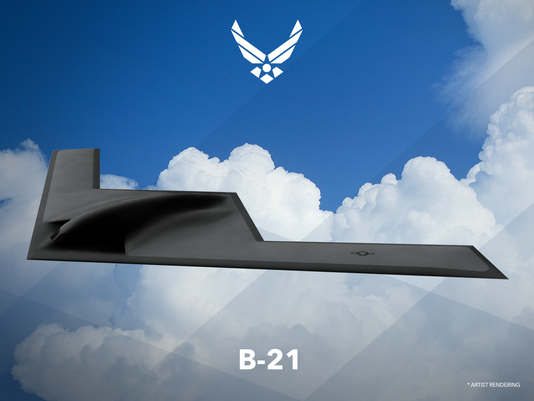
The latest B-21, meanwhile, looks like this:

A vision of the future, set in the present, but with echoes of the recent past. It's complicated, OK?

It's a slick looking plane that, it goes without saying, closely resembles the B-2, designed in the 1970s and first flown in the 1980s. It's also made by the same company, Northrop Grumman.

So here's the thing. As an aviation dork, I'm a little disappointed it doesn't look more exotic. I'm not sure what "more exotic" would mean here, to be honest, but as Justice Potter Stewart once said (kind of), I'd know it when I saw it. It's a B-2 with longer wing extensions and no saw-tooth trailing edge. Right?

There is, of course, a reason for that. The whole philosophy behind the LRS-B program was to use "mature" technology--that is, stuff we know works. That doesn't necessarily mean it's all stuff that is unclassified or old news, but it's proven. Which explains the shaping. The B-2's planform is aerodynamically efficient and nearly invisible to radar; why mess with success?

We know literally nothing about the B-21's capabilities at this point (or even how big it is, as the illustration doesn't give a sense of scale), but we can at least infer it is meant to be subsonic. The long wings we see up there provide lift and range, but the ain't made for breaking the sound barrier LINK.

That means what we've got here is an aircraft that looks like the previous generation in stealth, and isn't particularly fast. Is this ground for Panicking That We Have Wasted Money on a White Elephant? No. And here's why... I think.

I have pointed out in the past, with some annoyance, that Russia's and China's stealth entries get a lot of attention to their overall shaping without much consideration to the details. A plane can look stealthy without being stealthy, thanks to stuff like engine nozzles, canards, strakes, and so on. And in the end, it's what's under the hood--high-tech radar, efficient engines, datalinks--that makes a plane top of the line anyway.

And this is where I think the B-21 will necessarily take it to the next generation. Better engines will give it longer legs. Defensive systems like solid-state lasers are, publicly, nearly small and light enough to mount on a large airplane. Weapons are "smarter" and can be released from ever-increasing ranges to hit ever-smaller targets. Networking will probably allow the bomber to control, or work in concert with, a fleet of unmanned aircraft. And there is a very good chance the bomber itself will be "optionally manned"; for high-risk missions, it could be flown remotely, or by a computer.

Oh, and by the way, that -21 designation? That stands for 21st Century. What we see, in other words, may not be what we get, and no matter how much I wanted to see a chrome-plated, atmosphere-skipping SuperMegaBomber, that's probably for the best. If nothing else, it will give me plenty to blog about as more details follow the plane out of the shadows.

Tuesday, February 16, 2016

Way ahead of the curve

Many years ago, Mrs. Blog and I attended a music festival in Milwaukee. Don't worry--the story gets better from here.

The band I remember most was on a SummerFest sidestage, with the seating area half-full. "They're a Chicago band," Mrs. Blog told me. I hadn't heard of them. We sat down, beers in hand, as the band took the stage. The lead singer walked up to the mic, plugged in his guitar, waited a beat, then launched into a crunchy rock cover of "Crimson and Clover."

The band was OKGO. I bought a couple of EPs from their merch guy at that show, and their label-produced full-length CD later. It was good stuff! And, of course, you want to support your local artist.

Now, in 2016, [REDACTED] years later, they're not Beyonce famous. But they've made a name for themselves--as you probably know--by virtue of increasingly clever music videos involving stuff like treadmills, Rube Goldberg machines, marching bands and human LED displays.

Their latest video, for a (catchy) song called "Upside Down & Inside Out," takes it to another level, literally, and in a way that really appeals to the aviation nerd in me. First, watch the video:


Yeah, that's right. The entire video is shot in free-fall. Note, this is not zero gravity, although as Einstein would helpfully point out, it feels like the same thing, relatively speaking. The band is being affected by gravity just like everything else on the planet, but they are falling at the same rate as the plane they are flying in, so it feels like they aren't. This can be done in just about any plane by flying a parabolic arc:

Like a roller-coaster, but awesomer.

Neat! This is the same way astronauts train for zero-g environments. And--fun fact--when they're orbiting the Earth, they, too are being affected by gravity: they're in free fall, but are moving so fast they keep missing the ground. It's science!

Note, though, that this process only gets you a minute or so, at most, of free fall to work with at a time. So what OKGO did was do one continuous take, with pauses in the dancing and music (which were edited out later) for the times when the plane was climbing back to the top of the parabolic arc, and they were not in free fall. If you look closely you can see where free fall ends, about every 25 seconds, when all the performers are sitting or standing for a moment.

Here's what it looked like behind the scenes:


And finally, the icing on the nerd cake for me is that the whole thing is shot in a surplus Il-76, a ubiquitous ex-Soviet military transport aircraft. You can find them all over the world now, being used for i̶l̶l̶i̶c̶i̶t̶ private cargo hauling, foreign military operations and of course music videos.

I knew I liked OKGO the first time I saw them. But I never would have guessed they'd inspire an aviation blog post. To paraphrase Claude Debussy, it's not the notes, it's the nerdery between the notes.

Tuesday, December 8, 2015

Armed and dangerous

Let's see if this is possible. Let's see if I can write brief post about gun control that's actually brief.

It can be tough to sort through all the noise to get any signal on this issue. You have probably seen a lot of information thrown around since the San Bernardino shootings: That 2.5 million crimes are averted every year because of guns (laughable); that gun crime is way down since 1993 (true but misleading; the numbers have been same since 1998 or so); that a gun ban in Australia made a big impact in gun deaths there (complex, but probably accurate); and even that it's unthinkable to abridge a constitutional right (also laughably untrue--try buying an RPG or shouting "fire" in a crowded theater).

All of that obfuscates the one fact that is literally undeniable: Americans are killed by guns at an appalling rate. Way higher, UNBELIEVABLY higher, than peer nations... and even some third-world countries. To say this is untrue is to share a Venn diagram with moon landing hoax believers.


That's a problem. A public health problem, in that people are dying who shouldn't be. A human problem, in that sons, daughters, mothers, sons are being taken from their families. And even an economic problem, in that all that those people could contribute--from the big, like starting companies, to the small, like paying sales taxes--is obliterated forever.

Why are we so unwilling, as a country, to address it?

I think the biggest issue is that the problem seems more or less insurmountable now. Distractions like "let's fix mental illness!" ignore the glaringly obvious correlation between gun deaths and the number of guns. Yet no one is seriously proposing confiscating all guns. That's because it would be constitutionally questionable, at best, and also because there are so many guns. The NRA has spent the last 40 years  convincing America that we need more guns as "tools of macho vigilantism and even insurrection." Tons of other Americans, including me, have paid money to shoot firearms for fun, or own them at home for the same reason. So the heavily armed horse is way, way out of the barn, and isn't coming back.

It's easy at this point in the conversation to just throw up your hands and say, "Screw it! Nothing can be done." But that's a pretty lame attitude. That's not how we cured smallpox, integrated schools or made cars safer.

So here are some things we could do:
-Require liability insurance. It has been proven with other crimes that making them just slightly less convenient (or harder) to commit deters them. If, as when you buy a car, you have to obtain insurance, that will dent sales. It will also theoretically create economic incentives for insurance companies to find ways to make guns safer, for instance by funding more advanced smart gun systems.

-Mandate a much longer waiting period for buying a gun. Include an onerous background check. Training. The result is fewer gun sales, and guns in the hands of theoretically more stable, responsible owners.

-Make concealed carry illegal. This is probably the most controversial idea. But if we're serious about stopping mass shootings, we should understand that "good guys with guns" are unlikely to prevent such carnage. And worse, they present a complication to responding officers, who must now sort out who are the good shooters and who are the bad shooters before reacting. (Note that this is why, in the Oregon campus shooting, an actual armed student kept his gun holstered.) The U.S. is a modern nation, not Somalia, and if you feel scared enough to arm yourself for everyday life--and you're not in the military or in law enforcement--I would suggest that your money would be better spent on counseling.

-And this seems like the least-controversial idea anyone could suggest: Allow the CDC to study gun violence unfettered. Since 1996, the agency hasn't been able to examine gun violence with any kind of rigor. (Thanks, NRA!) Getting good, unbiased data on gun violence is the first step toward addressing it like the public health and safety issue it is.

The auto industry is a great example of how safety has been regulated into both the product and the user. It would be fantastic to see the same type of results with guns:


But nothing will change if we continue to just shrug our shoulders and complain that it's too big of a problem or too big of a burden on gun owners. Nothing resembling those two obstacles have stood in politicians' way as they happily tried to legislate  solutions to--just pulling an issue out of thin air here--terrorism. Terrorism, yes, which has killed exponentially fewer Americans since 2001 than gun violence. And no amount of gut-churning violence seems to be weighty enough to act as an inflection point. You would think the massacre of a bunch of children by a guy using legal firearms would have given us a push in the right direction. But that was years ago, and here we are again.

Like an addiction, the first step is admitting we have a problem. Denying it will just land us right back in the same bloody mess.

And so maybe the next post I write on the subject will actually be short. Maybe even just one word: "Finally!"

Thursday, November 12, 2015

A Tigershark and a Falcon Hawk walk into an arms market....

China is trying very hard to sell its J-31 Falcon Hawk (sometimes referred to at the Gyrfalcon) stealth fighter to other countries. Most recently, it was on display at the Dubai Airshow, where officials with its manufacturer, AVIC, promoted such features as:

-It has two engines
-It has vertical stabilizers (i.e. "tailfins")
-It can carry weapons

If you thought to yourself, "Self... aren't these features that many military aircraft have?" you'd be asking a legitimate question. But lest you think I'm exaggerating, here--watch the promotional video for yourself:


They didn't go into great detail about anything, as you can see. What is arguably the plane's biggest selling point, its stealthiness, is asserted without any quantification. What's the radar cross-section? How far away can it be detected? All open questions.

Another key detail not addressed was how much each plane would cost buyers. And here's the most important bit: there are no customers. A major aerospace company is selling a low-cost (maybe?) stealth fighter to anyone who wants it, but, well... no one wants it. Including the Chinese military, which is focusing on the J-20 and has no plans to buy any J-31s.

It's easy to mock AVIC for this. But this isn't the first time a company invested money in what it thought was a superior product, only to find its plane utterly ignored.

In the mid-1970s, the American defense giant Northrop (now Northrop Grumman, maker of such obscure aircraft as the B-2 stealth bomber) began developing a light fighter for export. The idea was to supply U.S. allies with a high-quality fighter that could defeat front-line Soviet gear, but not sell them top-of-the-line U.S. hardware, like the newly developed F-15.

Thus spawned the F-20 Tigershark. It was basically re-engineered F-5 Tiger II, with its wings and tail tweaked to improve maneuverability and a single engine that generated more than 50 percent more thrust that the F-5s two engines. Overall performance was, in the end, comparable to the more-expensive F-16. It looked like this:


Neat, right? But despite its relatively low cost and relatively high performance, there were no buyers. Well, Bahrain ordered a few, but they were never delivered. The biggest issue was that the U.S. changed its export policies, allowing better equipment--including the F-16--to be sold overseas. Northrop was never even able to sell any to the U.S. government. And so after the better part of a decade, Northrop abandoned the program after spending more than $1 billion on it.

So there are all kinds of factors at work with the J-31. Buyers who are allowed to purchase an F-35 or Eurofighter Typhoon probably will. Buyers who aren't--I'm looking at you here, Pakistan--are probably reluctant to shell out money for a plane that may or may not do any of the stuff its advertised to do. (And a J-31 buy would not generate goodwill with Washington, either.)

In the end, the J-31's problem is that it's probably just a dog, developed for Chinese use but discarded in favor of the superior J-20. AVIC is trying to get something back on its investment. But like Northrop, it might be better served moving on to the next project and leaving the Falcon Hawk alongside the Tigershark as a footnote to aviation history.

Tuesday, November 3, 2015

They did it. They did it!

After losing the World Series in seven games last season, the Kansas City Royals are once again world champs.

As I wrote last year, I have clear memories of the games, the celebrations across the city, the parade. I was right there in the middle of it in '85, a nine-year-old watching the games on TV at home and the victory parade on TV in the cafeteria of my elementary school.

Now I have literally never been farther from home--7,796 miles, if Google is to be trusted--and the Royals have done it again.

I wish I were there to celebrate with my Kansas Citian friends. I wish I had been there to watch some of the nail-biting late innings with my parents (and my dad, especially, who HATES nail-biting late innings). But in the end, I can't complain: I'm here with Mrs. Blog and the increasingly adorable Little Blog, and thanks to the Internet, I was able to follow nearly every minute of the post-season. That's literally a win-win.

And you know what? Thanks to that 7,800-mile distance, most of the games came on around breakfast time here in Hong Kong. And thanks to the extra innings, right around lunchtime on November 2, I was able to see this:


Go, Royals!

Thursday, September 3, 2015

Tragedy, journalism and everyday life

It's true, I think, that when you get into journalism you know you're signing up for being exposed to things you can't unsee.

When I was reporting in Chicago, there were dead people. And body bags. And violent crime scenes that hadn't been cleaned up. But even if you never leave the newsroom, you're surrounded by images--on TV, the Internet and in print--that aren't always wonderful.

Right now, I'm more or less in the second situation: I've got a desk, two monitors and a phone. I deal with business news in Asia, which is never more than metaphorically depressing. But the refugee situation in Europe means that, like most of the world, I've seen horrifying pictures of dead children on the beaches of the Mediterranean.

Like I said, you know you're signing up for it. And for better or worse I think you get kind of inured to it after a while.

But for me, the emotion leaks through sometimes. There are two times this happened to me that stick out in my memory.

Once was when I was covering the kidnapping and killing of a boy (a celebrity's nephew, actually) in Chicago. I interviewed some of his family's neighbors. Talked to the police. Did normal reporting things. Was fine. Then I saw the picture we had been given to use with the story. It was from his birthday party. He was seated at a table, holding a balloon. A huge, innocent, joyous smile just radiated from his face.

Someone had taken that kid--defenseless and innocent--and killed him. I came home from work that night and cried. It was hard to stop.

The second time was today. You've probably seen the picture too: a three-year-old Syrian boy, lying motionless in the surf in Turkey. You can't see his face. He's dressed in a tiny red T-shirt and tiny blue pants and tiny black shoes.

He died because his parents are war refugees, unable to travel normally, legally, to a safe haven. I cried (discreetly, because I'm a professional) at my desk.

The latest one hit me harder, I think, because I have a kid of my own. I dress her every day. Sometimes she wears tiny pants and a tiny T-shirt and tiny shoes. She's defenseless and wonderful and I never want anything bad to happen to her. So what happened to the Syrian toddler seems all the more tragic and unjust. His parents' choice was to risk their lives living in a war or risk their lives trying to claw their way into a more promising country.

That's not a fair choice. Developed countries have plenty of room to help those trying to escape war, or religious or political persecution. It's the right thing to do, but if you're more of a "how does it help the bottom line?" type, the economic benefits of immigration--legal and illegal--are pretty unambiguous, at least in the United States.

As for me, I'm glad I'm not too calloused to react emotionally like that. I'd be worried if I were. But I hope--naively, I know--that the world will improve, and there will just be fewer images like this for me to react to.

That's the world I want my daughter to live in. Not the one where generosity is seen as weakness, and refugees treated as a nuisance.