Showing posts with label hong kong. Show all posts

Saturday, December 9, 2017

Revenge of the Return of the Misc Box, Part II: The Boxening

Well, readers, I'm sure you're just as aware as I am that it has been a long time since we've exchanged electrons here on the blog. Like a long time. As usual, I will offer no excuses other than: life has become busier than usual.

Sure, Gerry, you may say. But that's true of all of us out here in the world, watching American democracy teeter and Hollywood greenlight remakes of movies that were great the first time around.

And you're right. We're all busy in our own way.

My particular way of being busy these days is another international move.

Mrs. Blog and I, now joined by Little and Littler Blog, as I guess I'm calling them, are moving to Singapore. And I have a new job, with another global news organization. New climate, new restaurants, new weird-but-iconic statues.

Weird-but-iconic merlion.

It's a whirlwind, moving a family. A real maelstrom of stress, planning and preparation. All you can do is keep putting one foot in front of the other, logistically and mentally speaking, until you're at your new home. At least that's the theory. We haven't arrived at that home yet, so I can't say for sure.

An artifact of previous international moves has been the existence, at the end of a day of packing up a home, of a catchall box. It's not full of one type of thing (like glasses) or even stuff that all goes in the same room (like the kitchen). No, it's a Misc Box that holds stuff you want to take with you but isn't easily categorized.

This time around, it doesn't look like we'll have one of those. That's partly because Mrs. Blog is an expert at organizing, and partly because this move will be the best supported in terms of relocation services. I won't go into the boring details, but it does appear that everything--regardless of categorization--will be neatly packed away, only to rematerialize in our new Singapore pad.

Instead there's a mental Misc Box. We've been here six years--my longest stretch in anyplace that's not Chicago or Kansas City. We have roots and friends and two little kids who were born here. What the movers can't take, but what I'm bringing with me, are those things. Those relationships, memories and experiences--good and bad--we found in Hong Kong. They'll always be with me, even if they defy categorization.

And so off we go. Soon we'll hop on an airplane, shake the dust of the 'Kong from our shoes, and embrace the future (which may or may not be devoid of chewing gum).

Hong Kong hasn't been perfect. But it's been home.

Sic transit gloria mundi.

Or as they say in Hong Kong, "Bye bye!"

Wednesday, October 22, 2014

Shades of 1985

It's been a busy month. Mrs. Blog and I now have Little Blog; Hong Kong is (extremely politely) demonstrating in favor of full democracy; and of course the Royals are in the World Series.

I'm still figuring the first two out, but I have some experience with the third one. I was in grade school when the Royals played the Cardinals in 1985. At the time I didn't realize it would be the last time in a long time they would even get into the playoffs.


The aftermath looked a bit like this.

Now, 29 years later, they're back. My perspective this time around is a little different because instead of being a kid surrounded by revelry in my hometown, I'm an adult surrounded by a near-total lack of interest in baseball, 7,500 miles away from home.

My memories are a little sepia-toned, as childhood recollections tend to be. My classmates and I (and our teachers, who were no doubt more interested) watched one of the day games in the cafeteria. There was a parade on TV. George Brett was king of the universe.

I have less personal experience with this team--although I did get to a game last year!--and it's much harder to watch them play live, but it's still cool. They have a great story, of a good regular season and a sparkling (undefeated until today's game against the Giants, booooo) postseason. The style of baseball they play is genuinely interesting, with lots of incremental moves to gain advantage, and disruptive speed. Their bullpen is outstanding. Come to think of it, it's kind of like watching "Major League."

Anyway. Scenes like this are amazing to see, even from afar...


... and I hope that despite the lackluster Game 1, there will be more to come. After all, way back in 1985, when the Earth was still cooling, Kansas City lost its first game against the Cardinals.

And we all know how that turned out.

Tuesday, October 29, 2013

It's that time of year


Ah, the winds of autumn. Here in Hong Kong, the signs are everywhere: leaves not falling from the trees, brisk chill absent from the air, apple cider and pumpkin spice lattes nowhere to be seen. (There are, however, plenty of people roasting chestnuts on streetcorners, but they do that during the summer too.)

And, oh yeah, college basketball. There's nary a sign of it in the 'Kong, but on Tuesday Kansas hits the court for the first time this season.


That's right--a shakycam video of a video screen in a basketball arena at... a glorified practice session this month. It doesn't get much dorkier than that. Fortunately, as noted above, actual basketball highlights are right around the corner. Happy autumn!

Sunday, June 23, 2013

The Snowden-storm

What's this? Yes, that's right--it's time for a current events post.

Today's current event: Ed Snowden leaves Hong Kong. And oh, how he did leave:

HONG KONG — The Hong Kong government announced on Sunday afternoon that it had allowed the departure from its territory of Edward J. Snowden, the former National Security Agency contractor who has acknowledged disclosing classified documents about United States government surveillance of Internet and telephone communications around the world.
The basic timing of this is that the U.S. last week asked Hong Kong to arrest Snowden. But, the Hong Kong government said, the U.S. didn't put the cover sheet on its TPS form. That meant that rather than being on a list that said "please arrest me when I try to leave the country," Snowden was able to hop on a commercial flight.

Hong Kong also managed to gently extend a middle finger at the NSA in the process:
Meanwhile, the HKSAR Government has formally written to the US Government requesting clarification on earlier reports about the hacking of computer systems in Hong Kong by US government agencies. The HKSAR Government will continue to follow up on the matter so as to protect the legal rights of the people of Hong Kong.

Very subtle, Hong Kong. Very subtle. So Hong Kong avoids having to deal with a fugitive they aren't particularly happy with, and also gets a little payback for being on the business end of some spy operations.

Snowden, of course, is on his way to Cuba and eventually Venezuela, according to Russian media reports on Sunday night. And that choice of cities is just one symptom of why I think his actions are problematic. Strictly speaking, he is not a whistle-blower; he did not reveal any illegal practices.

There is a strong argument that the troubling aspects if PRISM--spying on innocent Americans, for one--are unethical. And I can see why someone's conscience might drive him to tell the world about it.

But shedding light on U.S. hacking in China just seems like pot-stirring to me. Yes, the U.S. spies on other countries. That is neither shocking nor revelatory. And it came at an extremely politically sensitive time between America and China. It's hard to defend revealing all that in the name of liberty or justice.

Traveling to so many countries on the Cold War Hit Parade en route to avoiding prosecution doesn't seem like the smartest public relations move to me, either. It's hard to come across as anything other than a fugitive when the only places you're fleeing are ones that are, to some degree or another, hostile to your home country. (I won't even talk about how WikiLeaks is involved now.)

Venezuela, if that is indeed Snowden's final destination, seems to tick a lot of important boxes for him. It is a democracy, in name if not in fact. It is a comfortable place; there are, for instance, beaches. And its government has just enough animosity toward the U.S. to accept him as a political refugee instead of a fugitive.

So, Edward Snowden: congratulations on leaving the Special Administrative Region. It was fun having you here, creating a spy novel here in our quiet neck of the woods. (By the way, great premise for a novel: a guy carrying sensitive data is fleeing from intelligence agents. Everyone wants a piece of him. But to get to safety, he has to spend a night in a Moscow airport in transit. Go!) But I have a feeling the fun is really only getting started.

Wednesday, June 19, 2013

I win!

So, it turns out that Read Ink has been nominated for--and unilaterally declared winner of--a Leibster Award. As fellow blogger and Friend of the Blog Kirstin explains at her excellent Champagne- and expat life-focused blog, Rues de Geneve,

It's the Liebster Award, a sweet medal of honor (Liebster means Love, or Favorite, in German) that's to be passed from one blogger to another, recognizing those with under 200 followers (uhm, yeah sure, I qualify). It comes with a few caveats: One, answer some questions posed by the person giving you the award, two, pass it on to another blogger.

So there you go. Here's the award logo:


And here are my answers to...


The Questions!

Do you get up at the first ring of the alarm?
Depends on what you mean. I almost never use the snooze function, but often lie in bed for a while after the alarm goes off, contemplating why I'm awake. The length of contemplation depends on how early it is (and whether I have a flight to catch).
What’s the last non-essential thing you spent money on?
Coffee. 

What do you like/hate most about blogging?
Blogging is a wonderful outlet for ideas that are interesting--at least to me--but too small to warrant, say, a novel. And as an expat, it's a good way of staying in touch with the folks back in the United States of Awesome. I can't say that I hate anything about it, exactly, but I dislike the feeling that I should post something--even if I don't have anything particularly interesting to say that day--just to keep it up to date. 

Coffee?
Yes, thanks. A medium skim latte with an extra shot would be great. Hmm, maybe I should change my "non-essential" answer. 

What’s one place to visit on your bucket list?
Just one? OK. I would love to go to Mars. I'd settle for the Moon. 

Fess up: What’s your guilty pleasure TV show?
This one is going to leave a mark. My wife got me hooked on "So You Think You Can Dance." There, I said it. 

You get four main ingredients to cook with for a month (spices, oils, salt and pepper not included)--name them:
Barbecue sauce, ribs, brisket and beer. (I hope there is a gym nearby this theoretical kitchen.) 

Would you still write if no one were reading?
Funny you mention that. I don't get a ton of comments on the blog, so sometimes it DOES feel like no one is reading (although I know from looking at the site's metrics that I get a good amount of traffic). So yeah, I'd still write. It's good exercise for my brain and fingers, if nothing else.

What’s your worst habit?
Coffee. 

Do you drink all 8 glasses of water a day, every day? 
Nope. However, I drink a lot of other things, and they are all well over 90 percent water… so I'm hydrated.

Coming soon... a post linking to the next nominee and winner. Stay tuned!

Wednesday, March 13, 2013

Britannia rules, colonists drool

Much has been made in the last couple of days about the Falklands' vote to remain part of Britain. The decision was almost unanimous. How almost? There were three people (out of about 1,700 votes cast) who voted to leave British rule. That the Falklanders (Falklandians? Falklandish?) do not want to become part of Argentina--or at least leave the aegis of Britain--is abundantly clear.

Meanwhile, in another former British colony, Hong Kong, the South China Morning Post took a poll about how the Hong Kongers might hypothetically feel about returning to U.K. rule. The result was that nearly three in four respondents wanted to stop being a Special Administrative Region and get back to the good old days of the British Empire.

That would seem to be a pretty solid endorsement. But there are a couple of things that bear noting.

First of all, there are a few nuts and bolts issues. It's an online poll; anyone with an Internet connection can vote. That means there is no way of guaranteeing a good sample... or even guaranteeing that the voters are in Hong Kong. To put it another way, it's not remotely scientific. Maybe if it were, it would still get the same results. But even in that case, there's another problem.

Without additional questions, there is no real way of getting at the motivations for people's votes. In other words, do Hong Kongers yearn to be British pseudo-subjects again, or do they just not want to be part of China? What if another question or voting option were, "Should Hong Kong be an independent country?" What would the responses be?

This is important, because there is a lot of subtext to both the rejection of China and the embrace of Britain. Hong Kongers, in general, harbor a certain amount of annoyance and resentment of China, which many see as kind of an uncultured older brother. Mainlanders are derided for stuff like pooping in public, invading Hong Kong stores in search of baby formula and even swarming Hong Kong hospitals.


As far as ads go, it's not particularly subtle.

Every year since the handover, there are massive street demonstrations on July 1 by Hong Kongers who want to make sure China knows they value political autonomy, freedom of speech, and so on.

Many voices, (basically) one message.

In short, Hong Kongers seem warily OK with being part of China as long as China doesn't get too much up in their business. When it seems like mainland influence is becoming too strong--for instance, when there was a push to get pro-China history courses in Hong Kong schools--people flip out a little bit.

So when given the choice of playing by China's rules or Britain's, it's pretty easy to see how polling results would play out.

And to be perfectly fair here, British rule of Hong Kong went pretty well. I have visited other former imperial colonies that suffered from more oppression and economic manipulation, and are in much worse shape today. And it's not like anyone went around tearing down British statues here after the handover. Hong Kongers, at least the ones I have met, don't have much bad to say about the way things were.

The problem, in the end, is that the poll results represent a false dichotomy. In a whole universe of choices about who is in charge, it's hard to say what Hong Kong might decide it wants.

Britain didn't really have a choice about returning Hong Kong to China in 1997; the airport and most of the water supply were in the part of Hong Kong on which the 99-year lease was running out. (Hong Kong island could have remained Britain's in perpetuity.) Today, Hong Kongers don't really have a choice about whether they can leave Chinese rule.

But if you were to ask me my opinion, my one-man poll would show I think Hong Kong could function pretty well as an independent city-state, except for the small issue of funding a military.

Monday, January 28, 2013

The best defense....

In these heady days of McDonald's-dominated globalized economies, the idea of a world war seems far fetched. Resources, no matter how scarce, can always be traded for at a lower cost than mobilizing a military and doing some killin'. Conventional thinking is that small, "low-intensity" or "brush fire" conflicts will become more common even as large-scale confrontations become a thing of the past.

And it makes sense. Japan and China will posture for the fans back home about the national importance of some stupid islands, but in the end no one will pull a trigger... because even posturing carries economic consequences.

This is the way rational actors behave.

That leaves the other, crazier side of the coin to worry about. Places like North Korea, which by just about any standard seem to put somewhat random military goals above the welfare of their own people. Such "rogue states" are a major reason why the U.S. has poured billions of dollars into developing missile-defense systems of various kinds.

Some systems, like the one now deployed in Turkey, exist to shoot down shorter-range ballistic missiles that travel a few hundred miles and follow an unsophisticated ballistic trajectory. Thanks to math, they are easy to hit.

Other systems are designed to hit warheads in their "terminal" phase, which is to say after they are on their way down. This is tougher because not only are the warheads involved here generally traveling much faster, but they have to be completely destroyed or their explodey bits and pieces will continue on the same trajectory, landing more or less where they were aimed.


(Yes, that twisty maneuver at the beginning is deliberate.)


And finally, there's the toughest shot of all: the "mid-course" interception. Roughly put, this is the best time to blow up a missile, because it means it won't land where it is supposed to. It's also hard because it is incredibly high up--hundreds of miles--and involves tremendously high speeds.

The third one is probably most important if you're talking about dealing with serious threats from irrational actors. North Korea, for example, could use short-range missiles to hit Seoul, but would need an ICBM, perhaps modeled off their most recent successful rocket launch, to hit the United States.

And if you're shooting a missile that far, it's probably going to be a special delivery, i.e., nuclear, chemical or biological. Fun!

In terms of deterring people with huge arsenals, like Russia, anti-ballistic missile systems make little sense. Indeed, you could argue that they are not just a waste of money, but are destabilizing, because they offer one side the (false) belief that it could shoot first without suffering retaliation.

So again, that leaves the North Koreas of the world as the justification for developing these extremely tricky, extremely expensive systems.

It is on that note that we arrive at the punchline: China, North Korea's closest ally, just announced a "successful" test of a mid-course interception system.

China again carried out a land-based mid-course missile interception test within its territory Sunday.

Xinhua learned the news from the Information Bureau of China's Defense Ministry.

"The test has reached the preset goal," an official with the bureau said.

"The test is defensive in nature and targets no other country," he said.


For all the grumbling about U.S. interference in Asian affairs, it appears the continent's most powerful military is spending its money developing weapons to protect it not from a Western hegemony... but from its next-door neighbor.

Saturday, January 19, 2013

The Art of Old Guy Basketball, Part II

Good evening, dear readers. I write this to you from a chair, which is not in itself unusual, but it is a chair from which I will not easily rise. That's because for the first time since arriving in Hong Kong, I played ball.

Oh, yes.  The Parents of the Blog got me a basketball for Christmas. I had been in the market for one for a while; our digs in Hong Kong are basically surrounded by public sports facilities, including some nice basketball courts. Many a day I walked by, taunted by the pristine nets--not chains!--well-maintained backboards and playing surfaces that, as far as I could tell, appeared to be scrubbed weekly, if not daily.

Someone pays close enough attention to the courts that the trapezoidal "international" foul lane…

The geometry makes it more fair, or something.

… had been scrubbed out at some point and replaced with the NCAA standard free-throw lane. Not only that, but the NCAA three-point line, which was recently moved to 20 feet, 9 inches, was up to standard. And you could see where the old one was before the groundskeepers scrubbed it off.

How to use the NCAA three-point line.

Anyway, the point is, I had been wanting to get out and see how bad my shot had gotten since hooping it up in the Middle East. Today, I did it (after buying an air pump at Toys R US. Don't judge; the sporting goods store was "sold out" of pumps).

The result is, as I mentioned above, extremely sore knees. But I finally got a glimpse of what street basketball in Hong Kong means, at least in our little overplanned high-rise forest of a neighborhood. Several observations:

1) On the courts where I was playing, everyone wanted to be a guard.

2) No one played a ton of defense.

3) The average height was greater than that of the rest of Hong Kong, but still less than 6-foot-3, i.e., me.

That meant several things. Point (1) meant that I, a guy who somehow managed to be a post player in high school (second-most blocked shots in freshman history, holla!), had an advantage in not just height but know-how. Everyone was willing to give up position in the paint, no one seemed to see my patented, and by that I mean totally telegraphed, shoulder-fake coming, and I boxed the hell out of anything that moved.

Point (2) meant that when I did get away from the basket, I could square my shoulders, set my feet, not jump, and have a clean look at the hoop. It also meant that by playing any defense AT ALL, I could affect the game. This type of nominal guarding saved me the embarrassment of wheezing to a halt on a court full of young whippersnappers.

Point (3) meant the obvious--even my 36-year-old, bad-kneed self could get away with not jumping a whole lot and still getting rebounds, blocking shots, and so on.

In short: It was the perfect recipe for a game of Old Guy Basketball. I didn't dribble much. I passed a lot. I didn't shoot more than a couple of times beyond three feet. I was probably really annoying to anyone chasing a rebound under the basket.

And my team won.

I will take comfort in that as I ice my knees.

Monday, December 24, 2012

It's Christmas Eve, Babe

It's time of year again, Gentle Readers of the Blog, this time in the festively adorned Hong Kong. So pull up some nog, light a fire if you have a safe place to do so, and enjoy one of the most bittersweetest of bittersweet holiday songs ever in a Read Ink tradition.


Merry Christmas, Happy Holidays, and a Spectacular Et Cetera to you all!

Wednesday, December 19, 2012

The gift that keeps on giving*

Happy Holidays, dear readers. Shopping season is in its last violent throes; Hong Kong, for one, is overrun with people buying even more stuff than they usually do. I wouldn't go inside Sogo right now if you paid me.

But if you're looking for the perfect present that won't break the bank, have I got a great suggestion for you. It ticks off all the elements you could possibly want: Cheap (in this case, free), unusual, colorful, fun.

I am of course talking about a North Korean-made driving game in which you motor around a digitized Pyongyang.


Probably higher-resolution than the actual city.

Play it here, Comrades. And a Very Merry Dear Leadermas to you.

*until you violate the rules of the road and are thrown into a reeducation camp.

Sunday, December 2, 2012

Rockin' around the Clocken

One of the unfortunate things about life in the Middle East was the lack of a genuine local music scene. There were bands everywhere--including some truly killer cover bands--and big shows came through every couple of months, but there wasn't a lot of local musical innovation.

So it was with great pleasure that Mrs. Blog, the Sister-in-Law of the Blog and some Friends of the Blog came face to face with Chochukmo, a local band from Hong Kong. We were spending our Saturday night at an annual music festival with the unfortunate name of Clockenflap.

Note the classic "singing into the audio monitor" pose.

They put on a great show, with a lead singer whose body language could accurately be described as Jaggeresque and a broad-spectrum sound that the kids these days apparently call "math rock."

And the setting was terrific, too. It was cool and a little rainy, but the West Kowloon Cultural District is right on Victoria Harbor, meaning every performance had a spectacular, multicolored backdrop (or sidedrop, whatever).


Note the two giant Christmas trees.

Sure, the crowd made me feel slightly old at times (Hey! You kids! Quit with yer crowd-surfin', I can't see!), but it's hard to beat live, outdoor music on a Saturday night. And it's always good to hear a new band, even if I'm not totally sure how to pronounce its name.

Friday, November 30, 2012

Offensively Sweaty Gweilo IV: Packin' Heat

Greetings, dear readers. It's time once again for another installment in the occasional series of answers to your burning questions for Hong Kong's most overheated resident.

It's after Thanksgiving, kids, and you know what that means: Holiday lights are up, and the temperatures are down. I wasn't quite sure what to expect on either front--Mrs. Blog and I got here in late January, so the arrival of winter is a new thing for us. But I can safely say that things are definitely gettin' festive up in here, and in a development that seemed unimaginable in August, I am now wearing a coat to work. It is waterproof.

Q: Dear Offensively Sweaty Gweilo,
I see that you're now wearing a waterproof coat to work. Way to stay behind the curve! I have been wearing a fleece for several weeks now. You probably already have hypothermia.

A: Yep, I noticed that. But to be fair, you also carry an umbrella on sunny days. The thing is, though, it's still not cold--not really. Not like it was in Chicago. I could easily walk to work in shirtsleeves and not be particularly uncomfortable (assuming it's not raining. I'll get to that in a sec.). At night it has gotten just chilly enough, like in the 50s, to warrant a jacket. Plus, this particular jacket, which Mrs. Blog bought me in Beirut, is awesome, and I'm not ashamed to admit I'm glad I have an excuse to wear it.

Q: But OSG,
 it's raining so much! Aren't you afraid you'll ruin your coat? It is awesome, as you pointed out.

A: Aha! But my coat is waterproof. This also means I am somewhat protected if I'm caught without an umbrella... and that means I can leave my umbrella at home more often. Everyone wins, especially the people I accidentally poke with it on the subway.

Q: OSG,
In your home country, does it get gray and rainy just as you're putting up holiday lights?

A: Depends on where you are, really. In Chicago, my most recent city of residence in the United States of Awesome, it tended to be a little cloudier during the winter. But mostly it just got cold. The cold of deep space. The cold of a Antarctic grave. The cold of a political strtegist's heart. Often, the sun would be shining on what appeared to be a beautiful day, but when you went outside, your tears would freeze. Anyway, the point is, is that there were lots of beautiful decorations, but it would often be more comfortable to view them from inside.

Q: Hey, OSG,
What are you doing to get into the holiday spirit? Besides listening to all the Christmas music playing in our grocery stores over... and over... and over.

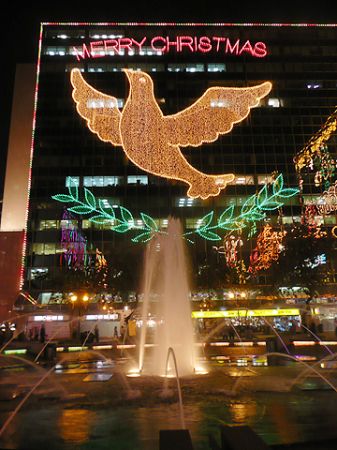
A: Well, we're getting a tree! That's a big step--it's our first actual Christmas tree since we moved overseas. So exciting that I'm not even really concerned about cleaning up all the pine needles afterward. We're also enjoying all the holiday lights that have sprung up in the last month or so. My office building, the festively named K. Wah Centre, is festooned with an almost-complete holiday message in 20-foot-tall letters made of colored lights. It currently reads "Erry XM," but I'm sure they'll get it finished by the time XM rolls around.
In the meantime, Hong Kong, a city with an impressive skyline already, is becoming full of displays like this:


Megawatts' worth of peace on earth.

And our apartment is getting full of visitors. That's the kind of thing that warms a heart, no matter how kind-of cold and perpetually rainy things get outside.

Monday, October 1, 2012

Whatever floats your boat


China has been in the news a lot lately. The presumptive next president, Xi Jinping, disappeared for a bit last month. The country was kept in the dark about the Communist Party meeting in which the country's leadership will be swapped out, then told it would be delayed until November. The economy continues to sputter.

But the most important news of all--if you get your news from Chinese media--is a fancy new aircraft carrier that was officially "launched" last week. Here's the thing, though. It's not fancy. It's not new. It's not armed. And there is no one trained to use it.

You would never know this from all the attention it is getting, though.

The aircraft carrier was originally launched by the Soviet Navy in 1988. But of course the Soviet Union was in its last days at that point, and the ship--eventually christened the Varyag--was never fully outfitted for combat. By the mid-90s, it had been stripped of pretty much any useful machinery, including engines. And in 1998, China bought it.

That's the provenance of the Chinese carrier, now called the Liaoning. Now let's talk about its capabilities.

As designed, it was essentially a complement to a larger fleet, not the centerpiece of a battle group. Its lack of catapults limited the types of planes it could use; essentially, it could provide combat patrols over the fleet and conduct limited anti-ship or interdiction missions with its two dozen or so aircraft. In short, its purpose is not to project massive offensive firepower, but to provide cover for missile cruisers. (Indeed, another type of Soviet carrier tried to combine both roles.)

Ski jump: great for catching righteous air, but not for launching righteously large aircraft.

This is a sharp contrast to U.S. carrier design. America basically fields two types: supercarriers and amphibious assault craft.

Supercarriers--typified at the moment by the Nimitz class--are meant to project power. They are the focal point of a carrier strike group, which involves other surface ships and submarines, and are what battleships were 75 years ago: the big guns. They carry nearly 100 aircraft, including strike fighters, airborne warning and control planes, electronic warfare, helicopters, and so on. Because it is catapult-equipped, it can also launch heavier air-refueling tankers--and that means the carrier's fighters can theoretically strike targets or patrol airspace over a thousand miles.

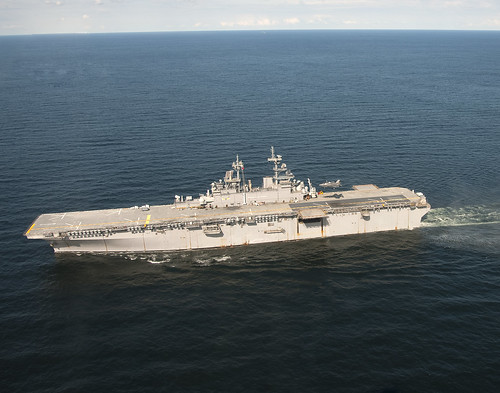
Amphibious assault craft are the province of the U.S. Marines and can be equipped in a variety of ways. Overall, though, the Wasp class carries a mix of several dozen fixed-wing aircraft and helicopters, plus a bunch of Marines and a complement of amphibous-landing craft: either LCAC hovercraft or other vehicles.

They also are used to test-fly awesome-looking next-generation fighters.

The Liaoning is nearly the length of a Nimitz-class ship--just a few hundred feet shorter at the waterline. It's a bit heavier than the Wasp class, weighing in at about 50,000 tons compared with 41,000. (Nimitz-class ships typically displace more than 100,000 tons.)

But the important point here is that it is a military match for neither. The nuclear-fueled Nimitz can travel indefinitely, limited only by food supplies. The Wasp has a range of more than 9,000 nautical miles. The Laioning has a range of only 3,800 nautical miles.

Worse, it can't land troops like the Wasp, nor can it control as much airspace as a Nimitz. Designed to protect other ships, the Laioning would essentially have to devote its entire air wing to protecting itself, leaving it with no offensive firepower to spare. In short, it can't project power or even provide a punch beyond what a group of missile cruisers would give on their own. It is a target.

Unfortunately for the Liaoning, that's not even the end of the story.

This is China's first aircraft carrier. That means that the military must now train several thousand seamen to operate the thing--no small feat considering the number of moving parts in modern carrier operations. With such a tiny margin for error and lots of munitions and jet fuel around, mistakes have major consequences. And actually landing on a carrier? That's one of the most difficult feats in aviation. Chinese pilots must be trained to fly carrier-capable aircraft. That aircraft will be the J-15, a copy of the Su-33. And the thing about the J-15 is that it doesn't exist yet.

To sum up, China now has a 25-year-old carrier that can't go very far and has no airplanes or trained pilots to fly them.

In the PLAN's defense, you have to start somewhere. The Liaoning is, at its heart, a proof-of-concept system. Crews will train there, the J-15 will eventually be test-flown there and a decade or so down the line, the navy will have the capability to run a combat-capable carrier. Is the Liaoning that carrier? Not a chance.

So why all the fanfare about this thing? It's simple. If China can get the world to worry about its aircraft carrier, bigger threats--like economic slowdowns and messy power transfers--will disappear in its wake. And that's more dangerous than the Liaoning will ever be.

Friday, September 28, 2012

Democracy in action


My fellow Americans (and everyone else), I come before you today to discuss that most American of all Greek-invented activities: voting. It is an act that is simple on its face--voicing support for someone to represent you in creating legislation and governance--but complex in execution and effect. Sometimes there's no one out there who represents your ideals. Sometimes the person who DOES represent your ideals has no shot of winning. And sometimes the person you vote for and wins ends up not really doing what you expected.

All part of the process. It's one I have been enjoying and growing into for nearly two decades now. Living abroad has given me a different perspective on democracy in a lot of ways, of course; in the Middle East, democracy doesn't really exist, so it was always interesting to explain to people that, in my opinion, it was better for people in a given country to be able to peacefully kick out whoever was running the country than to just allow someone to be in charge because of their surname. The results are messy and almost always imperfect, but on the whole, pretty nifty.

This year will be the first time I vote in a general election while living overseas. I know, I know… there was a congressional election in 2010, and I am a terrible American who did not participate. This was not out of protest or apathy, but simple laziness. As a citizen relatively new to overseas life, it seemed impossibly difficult to, you know, vote from 5,000 miles away.

The reality, though, is that it is impossibly easy to vote from 5,000 miles away. Or 7,000 miles away, as the case is now in 2012. You tell your most recent voting jurisdiction where you are--via a form you can e-mail--and that you would like a ballot. They e-mail you the ballot. You fill out the ballot and mail it back. The end. Democracy rules!

What democracy looks like.

If anything, it's actually easier than voting in the U.S., which requires me to do insane stuff like leave the house, walk a few blocks and wait in line for 10 minutes. And if you thought living 15 hours (direct flight!) from the continental U.S. meant I was far removed from the craziness of campaign season, think again. Mitt Romney had a fundraiser here in Hong Kong on Thursday night.

Wrong flag. But hey, there weren't any pictures taken at the fundraiser, so what do you want from me?

And there's one other interesting issue at play here. About 5 million Americans live outside the United States. If, like me, they are casting their ballots now, the homestretch of the campaign--including all three presidential debates--simply does not matter. I guess that's a good and a bad thing. On the one hand, if everyone in the U.S. voted early, it might mean a little less money spent on incredibly annoying partisan advertising. On the other hand, it might also just mean that most people have their minds made up already, no matter how hard any candidate campaigns. So much for intellectual discourse and persuasion.

Whatever. What it means for me is a lot more obvious: I get to cast my vote, then sit back and watch (or ignore) the fireworks.  And because I live 7,000 miles away, those fireworks will occur around breakfast time on Nov. 7. Breakfast fireworks and easy voting: now that's a platform anyone could get behind.

Monday, September 24, 2012

What market forces sound like

Hong Kong, like many large Asian cities, is up to its neck in electronics and gizmos. Cell phones, for instance, are beyond ubiquitous--you can buy any model of any manufacturer in stores ranging from alleyway carts to big-box department stores. Computers, too, are sold anywhere you can tack up a piece of neon. When you ride the train, nine out of every 10 passengers are using one or the other during their commute. Even taxi dashboards are festooned with gadgets, from front-facing cameras to dueling GPS systems to DVD players... plus, of course, cell phones of assorted shapes and sizes.

It was against this backdrop that Mrs. Blog and I optimistically set out to find a new stereo system for our new Hong Kong apartment. The goal was three-fold: eliminate much-hated wiring, streamline the appearance of our A/V setup (we are currently rocking a Panasonic Dolby 5.1 system with the rear speakers and subwoofer--and their several hundred feet of wires--disconnected), and subject our surroundings to stunning sound.

A component system was out of the question; Hong Kong being Hong Kong, we needed to keep it small and simple. Shelf systems were too tall; any 5.1 system involved more thousands of feet of wires. And then we found this:
Cue the angelic choir (in simulated surround sound)

A soundbar. With a wireless subwoofer. Its multiple HDMI ports meant I could run all of our A/V stuff into the reciever, leaving just one cord running to the TV. The wireless sub meant we could hide it behind a chair. And its minimalist styling meant all the previous clutter would melt away to nothing.

Great! Solution found. For one reason or another, we put off actually getting it, though. We were out of town... we had guests... needed to do more research... and so on. And you know what the punchline here is, right? When we finally went to go buy it, there were none to be found.

Hong Kong, it seems, has a very short built-in shelf life for electronics. In Abu Dhabi, you were likely to find last year's products advertised as though they were brand new. Here, last year's products (the Sony soundbar above was released in the second quarter of 2011) are treated like rotten fruit. Why keep 'em around? No one wants to eat a mushy banana.

All the newer models from other manufacturers at the moment in Hong Kong are no good for our purposes: maybe the subwoofer is wired, maybe they use an optical port instead of HDMI for some reason, maybe the design is ugly, maybe it just sounds bad. And there is little sign of new soundbar releases on the horizon for Hong Kong; customers in the Special Administrative Region clearly prefer component or shelf systems, of which there are dozens of options in every single electronics store.

So, what do market forces here sound like? For now, they sound like an old stereo or a saleseman saying "Sorry, not in stock." But one hopes that maybe by the time the holiday shopping season rolls around, stores in these parts will be singing a happier tune.

Wednesday, September 19, 2012

Another non-stealthy rollout

By now, you may have seen pictures of what appears to be China's latest foray into the world of stealthy combat aircraft, the J-31. It is, like its predecessor, a neat looking plane.

But once again, I have to say "appears," because although it looks like a stealth and quacks like a stealth, those qualities do not make it a stealth. Materials, internal structure, avionics and even paint are a huge part of making an aircraft low-observable.

And even BEING low-observable does not mean an aircraft is 100 percent invulnerable (as the U.S. learned in Yugoslavia). The radar cross-sections of the B-2 and F-22, the leaders in this field, are not published, but are widely assumed to be minuscule. But even these will show up as flickers on the screens of low-frequency radars, and X-band fire-control radars can conceivably pick up some hint of them too... but only at close range. Like, "bombs already are falling" close.

And that's the key: It's not about being invisible, it's about being invisible at a range where you can shoot and the other guy can't. Which the U.S. stealth offerings seem to be able to do marvelously.

And that brings us back to the J-31. It definitely looks a lot like a twin-engined version of the F-35, as noted aviation observer Bill Sweetman points out. It also isn't exactly being kept under tight wraps:

 Literally in broad daylight.

Insinuations of design-copying aside, what does any of this tell us? Is this a program to be feared? Are the J-31 and J-20 challenging American air dominance?

Not likely. And that's mostly because, as I said, it's what is under the hood that counts. Basic design elements (like canards and "turkey feather" tailpipes) are clearly unstealthy. The engines are Russian-made. And outside of a stealthy shape, there is no indication the Chinese have perfected key items like low-probability-of-intercept radar, which means an aircraft can actively search for targets without giving its position away.

Even with an accelerated flight-testing program, both of these aircraft are 20 years behind the technology that produced the F-22. The F-35 (which Sweetman hates) is, despite having a less-impressive flight envelope than the F-22, a step forward in avionics and networking--more "under the hood" stuff. What's more, the Navy is five or so years away from fielding stealthy, unmanned combat aircraft and the military is taking proposals for the next generation of fighters. By the time the J-20 and J-31 are being mass produced, if that ever happens, they will already be out of date, and fleets of F-35s should (fingers crossed) already be in the hands of allies around the world, including Japan and Korea.

The J-31 and J-20 will always look awesome. But in the real world, looks aren't what count the most.

Monday, September 10, 2012

Ask an Offensively Sweaty Gweilo III: Playing it Cool

Hello, faithful followers of this irregular column. It's been a while since our last installment--which found the titular gweilo swimming in perspiration mid-summer--and there is news to report. Specifically, the arrival of autumn.

Summer was not. Not Abu Dhabi Hot, but uncomfortably warm, especially when walking to work in long sleeves. It was also wet. We had a big ol' typhoon, and for a while there it was raining almost every day.

September, though, seems to have been equipped with a meteorological "off" switch for all that stuff. It's sunny. It's breezy. And most important, I can make it from the MTR stop to my office without mopping my brow even once.

So with that in mind, let's dive into the totally-not-made-up mailbag:

Q: Dear Offensively Sweaty Gweilo: It's great that you're not offensively sweaty anymore, but I have noticed you still don't make much of an effort to stay in the shade. Don't you know what the sun will do to you? Carry an umbrella!

A: Oh, trust me--I am well aware of what the sun will do to me. I am familiar with the sting of denim on a sunburn and the soothing properties of aloe. But one cannot live in fear, right? And if nothing else, I'd like to get a little bit more color; I may never be anything but a "ghost man," but a bit of tan actually makes time in the sun more tolerable. That's one reason why I don't carry an umbrella. The other is that it's not raining. And when you've got 8 million people packed into a tiny island, carrying an umbrella to protect you from the sun AND the rain can get a little awkward, no?

Q: Hey, OSG--we noticed you at a Mexican joint in TST the other night. You're always making noise about finding good comida Mexicana outside North America... what did you think? (P.S. You did not appear to be sweaty)

A: Sharp eyes. Yes, Mrs. Blog and I went to place over there to meet some friends. And you're right--I was not sweaty. We were actually right underneath an air conditioning vent, which kept me a normal temperature and made Mrs. Blog chilly. As for the food, well... they have great happy hour drink specials. The search for excellent Mexican food continues, and I'll let you know if there are any developments. There is actually a place in our neighborhood that is supposed to be pretty good, but it has always been closed when we try to drop by.

Q: OSG, in your homeland, fall means the start of football. How's that going in Hong Kong?

A: Not well, both in terms of watching it and results. I can't say that the air here is crisp and full of the delicious aromas of tailgating, so my normal instinctual drive to find a game is not at its peak. But even if I did want to watch a game, they start--at the earliest--at midnight Hong Kong time. And also they're not on TV, meaning I would have to resort to [REDACTED] measures. On the plus side, both my beloved Jayhawks and Chiefs lost their games this weekend, so at least my eyeballs didn't have to endure that.

And that's it for the September edition of AOSGA. Remember, keep those questions coming, stay cool and please... look where you're going when you're carrying an umbrella.

Sunday, September 2, 2012

Droppin' Hong Kong dimes*


Hong Kong is a big place--or at least a lot of people in a small place--but even so, I can't believe I missed Kevin Durant's visit here. Worse, I apparently walked right by Southorn Playground when he was playing some pickup ball.


Showing off for a different Hong Kong crowd.

How do you miss a 6-foot-9 shooting guard in a place where the average height is something like 5-9? I dunno, but it happened. Doesn't say much for my court vision, does it?

*worth approximately $0.013

Sunday, July 29, 2012

Ground control to major exhibition

As I mentioned before, China's space program has landed in our little corner of Hong Kong. A display of rocket models, space paraphernalia ranging from a toilet (er...) to a space capsule and informational signs have been set up in CityPlaza for the last month.

Most of that time, I was in the United States of Awesome. But last week, as it was raining for the fifth (or sixth? I lost count) consecutive day, Mrs. Blog and I decided to do a little mallwalking in space. Or spacewalking in the mall. Whatever, we went to look at the exhibit.

Visitors are greeted by six giant models of China's launchers. Five of them are for unmanned projects; one of those five still has not been launched because it is awaiting a facility large enough to accommodate it. One was used for the Shenzhou manned program.


 What's white and red and flies all over?

A bit down the hall, there is a smattering of additional models, plus some real, live hardware. Here's what the Shenzhou capsule stack looks like, with service and docking modules on either end:


Big, but not as big as the real thing.

Next to it was a model of the Tiangong assembly, which was used to perform tests of in-orbit docking:

Like a mobile home in the stars.

It will be used as a basis for China's planned space station program. Next to it (and behind the model in the second photo) there was an escape tower for a Shenzhou capsule that actually flew. The tower is discarded after the rocket hits a certain speed and altitude. Before that, it can accelerate the manned portion of the rocket--the capsule--if there is an emergency.

Also on display were random items from everyday life in space: food pouches, the aforementioned toilet, a sleeping bag, canteens, and my personal favorite, the space tray:

You know it's a space tray because it's decorated with an astronaut!

And finally, the main event. I posted a picture of this before when they were setting up the exhibit, but now the real, only-been-used-once Shenzhou capsule is all prettified, with glittering rocks underfoot, a spacesuit standing guard and its parachute draped overhead:

 One small capsule for three people. One giant leap for the Chinese space program.

Overall, an impressive setup. China has come a long way in a short amount of time; of course, its space program also has benefited greatly from all the space exploration of the last 60 years, so the nation's scientists know what works and what doesn't, and how to do it right. The Chinese also have universities that can train rocket scientists and the resources to build those rockets. Theoretically, they have a high ceiling indeed.

But I remain optimistic the U.S. will win the race for a mall exhibit of Mars landings.

Tuesday, July 24, 2012

The Great Typhoon of Aught-12

Sunday evening, there was a tropical storm named Vicente plowing along more than 250 kilometers south of Hong Kong. It was headed almost due west, and its 100-kilometer-per hour (about 60 mph) winds were projected to make landfall somewhere in China.

But when I woke up on Monday, the storm had turned 90 degrees to the right, which put it on a due-north course... directly at the Special Administrative Region. The Hong Kong Observatory issued this warning, known as "hoisting the signal":


That meant: "Strong wind is expected or blowing generally in Hong Kong near sea level, with a sustained speed of 41-62 kilometres per hour (km/h), and gusts which may exceed 110 km/h, and the wind condition is expected to persist."


But as the day went on, it became evident that Vicente was not going to deviate from his course again. And the storm grew stronger, with sustained winds of up to 120 kph near its center. By midafternoon, the observatory announced it would be increasing the warning to this...


... before 6 p.m., meaning "gale or storm force wind is expected or blowing generally in Hong Kong near sea level, with a sustained wind speed of 63-117 km/h from the quarter indicated and gusts which may
exceed 180 km/h." And looking out my office window, I could see why. The rain was pretty much nonstop, and winds lashed the side of the building. When it was clear enough, I could see trees bending and whitecaps on the harbor. Once the Number 8 flag was raised, everyone in my office (and every office across Hong Kong) was obligated to go home. Taxis disappeared. Buses stopped running. And although my commute home entailed literally two minutes where I was not sheltered from the storm, I arrived at our front door looking as though I had taken a fully clothed shower. Umbrellas don't protect against horizontal rain, and even if they did, it wouldn't have mattered--mine turned inside out.

I took a picture of the storm as seen from the base of our building, and I don't know what to tell you--it was much more impressive in person.

If the wind had changed direction, I would have been soaked.


Anyway. Safely ensconced in our high-rise, I, Mrs. Blog and a friend turned what had been planned as a low-key taco night into an impromptu typhoon watch party. Tacos and gale-force winds... what's not to love?

Documenting the guts of the storm at night with my iPhone would have been difficult, I think. You saw the picture of what it was like outside. Inside our local department store, there were a few effects:


 Protected from the elements?


But it was a pretty intense experience. The high winds caused our ears to pop when they blew at our building from the right direction. Our poor air conditioner struggled as gale-force winds battered its exhaust vent. Rain pounded against the windows with a vicious insistence. And overnight, the storm intensified according to the observatory. First to a nine:

Which meant "gale or storm force wind is increasing or expected to increase significantly in strength," and then to a 10:

Ten is the second-highest warning they can issue here, and the most recent hoisting of the 10 signal was in 1999. Officially, it means "Hurricane force wind is expected or blowing with sustained speed reaching upwards from 118 km/h and gusts that may exceed 220 km/h," and practically, it means stay inside and keep your head down. There are a lot of glass-faced buildings in Hong Kong; all of the businesses I passed last night had taped their windows or fixed boards over them.

And I guess it all paid off. Supposedly only about 100 people were injured and no one was killed. This morning the storm was downgraded to an 8, then back to a 3. Now it's just windy. And on the streets, it's business as usual... almost.

 A relatively calm morning... but the PLAN is still parked outside my apartment.


Signs of the storm were everywhere. On the highway exit near our building (which you saw from street level in the first picture I posted), trees sprawled across the road.


Just another commuting obstacle.


On train stop where I get off for work, the crowds to get on the train were so thick they spilled from the platform back into the hallways leading to the platform. Only a few dozen passengers could make it onto each train.


 Fortunately I was going the other direction.


On the street, there was detritus everywhere. Remember how I told you my umbrella turned inside out? The sidewalks were a graveyard of umbrella devastation.


Not storm-proof.


Signs had blown down, leaves were strewn about and a lot of businesses were still closed, despite the crowds of commuters.

 Some umbrellas didn't even make it to the trash can.


Which direction was the wind blowing last night? Let's ask these trees (the air was calm when I took this picture):


The answer appears to be west.

And that's the story of Typhoon Vicente, as seen from about 100 kilometers from the storm's center. It has moved on now, passing almost directly over Macao and making landfall at Huangmaohai.

There is only one higher level of typhoon warning, the "10 signal plus black rain." That is not likely to happen while I'm here. But until it does, I can say Mrs. Blog and I made it through the biggest typhoon to hit Hong Kong in more than a decade... and toasted it with margaritas.