Wednesday, June 11, 2014

"Wise man"? Really?

The idea that we, as human beings, are inherently rational (see the "sapiens" in homo sapiens) is being stretched to the breaking point lately for me. I say this because a sapient being--or a society of sapient beings--should be able to process tangible, real-world evidence, draw conclusions from it and plan future behavior based on those conclusions. That's how humans came to dominate the planet, after all.

But these days, that doesn't seem to be happening.

For instance, there are mountains of data showing that the Earth's climate is changing in direct correlation with the amount of carbon dioxide we're pumping into the atmosphere. And if that weren't tangible enough, there is also the small fact of Antarctic ice measurably and inexorably sliding into the ocean... which will raise sea levels by amounts ranging from problematic to catastrophic in the next hundred-plus years. Tangible. Real world.

But instead of guiding humanity to action, this stuff has become a political football. I can't think of another area of science that is so settled yet "debated" (note: those are irony quotes) so heavily along political lines. Look it it this way: denying manmade climate change puts you in roughly the same scientific sphere as believing vaccines cause autism and just a notch or two above denying evolution. Is that a good crowd to run with? Is that what we want to base policy on?

Here's another example: guns. I could go on at great length about this, but The Onion, as always, is able to wrap it up in a tight little satirical package:

No need for a caption.

In this case, the real-world, tangible evidence is an ever-larger pile of deadly shootings. It doesn't get much more tangible than that. Yet the U.S. has done basically nothing additional to regulate the instruments of those shootings. To the contrary, public discourse becomes flooded with  sophistic arguments about how the shootings are caused by anything but firearms. (Quick side note here, touching on something that fascinates Friend of the Blog Pete: I do enjoy guns and military hardware. The technology behind them is brilliant and the tactics and strategy in their use on the battlefield is engrossing. Yet, barring a zombie apocalypse, there will never be a gun in my home.)

And so homo sapiens looks at his surroundings and shrugs, figuring it's easier to make up his own reality. This isn't the attitude that made our species strong. But it may be the attitude that lays it low.

Sunday, May 18, 2014

A numbers game

A while ago, I wrote about a few "things"--mysteries and former mysteries--that were inspirational to a writer of speculative words like myself. One of those things was "numbers stations": radio channels that went on the air occasionally and broadcast a seemingly random series of numbers, letters or words. Although it is widely assumed the stations are for spies doing spy things, nothing has ever been definitively proven. Fascinating!

Today I came across an interesting post on Kotaku that seemed to push the numbers stations into the 21st Century.


Thousands and thousands of videos, uploaded nearly every day. Each one is the same, structure-wise: 10 slides of shapes, shown over 11 seconds, over various random tones. Nobody has a clue what the videos are supposed to be, much less who is uploading them or why.

Just today, the channel has uploaded over a dozen bizarre videos.

Here's the idea. If you're reaching out to your espionage buddies, using the Internet--and a public corner of it, no less--broadens the scope of transmission to, well, the entire world. Here's what the YouTube videos look like:


Sure, sure, sure. It could be a completely innocent series of videos with no deeper meaning. But that's boring. Instead, let's assume it is a series of coded messages about something super-secret, super-important and super-awesome in some way. If nothing else, it's a super-intriguing jumping-off point for a great story.

Sunday, May 11, 2014

The right stuff

Like any era, the current one has plenty of grumbling about "those damn kids" and about how "men were men" back in the day. It's always been that way. And so it was when Bill Dana, one of the most accomplished test pilots in world history, died last week. A common reaction was that when men were men, you see, people flew by the seat of their pants and didn't care about no namby-pamby rules.

But that's not the way it was at all.

Flight testing has always pushed the limits, and always will. Sometimes it seems like programs took more risks back in the '50s, '60s and '70s, and I think that's true to a certain extent. There were definitely more risks, but that was largely a function of where technology and science stood.

For instance, we know much more about how extremely high Mach-number flight works, have much better computer systems, and have satellites that enable communications anywhere, anytime. The result? We didn't strap a man onto the top of an ICBM and send him hurtling downrange at Mach 20 in DARPA's Falcon program. That's good, because...


In short, we are pushing into more dangerous flight regimes than ever before, and can gather data without putting a person at risk. That's not a bad thing.

More to the point, though, guys like Dana didn't fly by the seat of their pants. He was an engineer with a master's degree who pushed aircraft as far as he could, and could analyze and explain what worked and what didn't.

Good flying leads to good photo ops (that's Dana in the foreground).

So what is the right stuff, which Tom Wolfe wrote about and Dana more or less embodied? It's knowing how to fly, sure. It's having the courage to push the aircraft. But it's also being smart enough to understand why it's happening (and why to follow the namby-pamby rules). And fortunately those qualities are still here in the 21st Century.

Tuesday, April 22, 2014

Return of the Triangle

One of the nice things about going on vacation is being disconnected from current events (even though the hotel Mrs. Blog and I stayed at helpfully provided a U.S.-focused photocopied summary of the day's news each morning). One of the bad things about that, though, is missing stuff like this:

It's a bird! It's a plane! It's... kind of like a Dorito.

Yep. That's another picture of what appears to be the same aircraft photographed here. The picture above was taken in Kansas, by a guy whose name seems really familiar to me for some reason. The other pictures were taken in Texas.

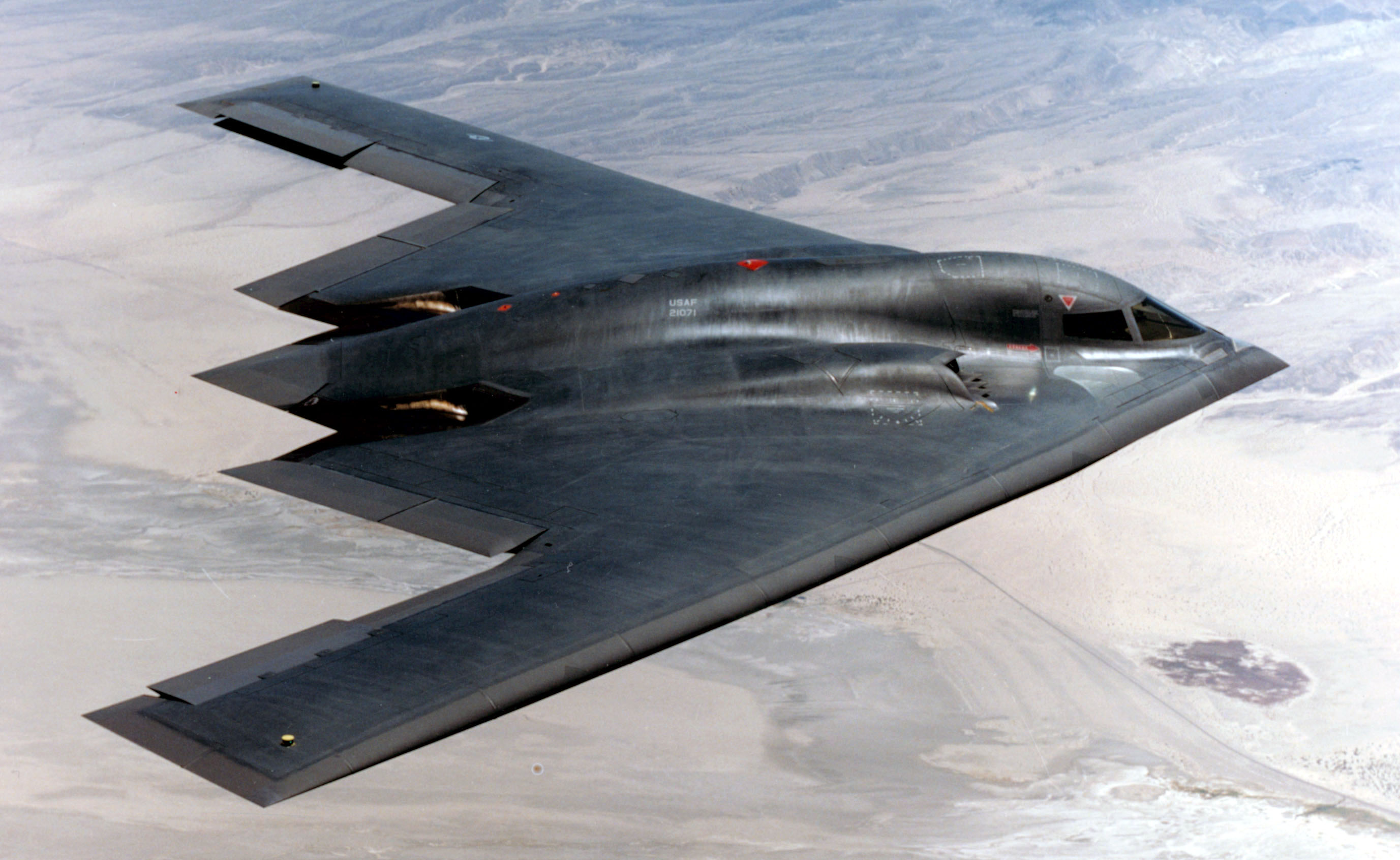
What they both have in common is a pretty clear "pure delta" shape--in other words, a plane that is basically a flying triangle. As far as I know there is no aircraft in the U.S. inventory shaped like that. Even the fanciest new drones--the X-47B, the RQ-170 and the RQ-180, for instance--do not have smooth trailing edges. Neither does the B-2:

Sawtoothed, not smooth.

So this once again appears to be a photograph of a large-ish aircraft of unknown purpose flying at high altitude (as indicated by the contrails) and below the speed of sound (as indicated by the lack of anyone hearing a sonic boom). This is almost certainly a brand-new program, and its flights over populated areas are almost certainly not mistakes.

Interesting side note: More than 20 years ago, the Navy was on the verge of acquiring a stealthy attack aircraft called the A-12 Avenger II. The program was canceled for costing too much and delivering, well, nothing. But guess what the nickname for the Avenger was? The Flying Dorito.

It never flew. But it did look like a snack chip.

Looks a lot like what's in the Texas and Kansas photos, doesn't it? But by all accounts, the program was a dog and, quite literally, never got off the ground. The similarities are probably coincidental.

My guess is that the pictures show the long-planned Long-Range Strike Bomber. But given the frequency of these sightings, it's only a matter of time before we find out for sure.

Tuesday, April 8, 2014

Can tractor beams be far behind?

Just a quick post in the vein of  “science fiction got it right for once.” Laser weapons are on the cusp of being reality, for better or worse. Now, it seems, so are electromagnetic rail guns—(that’s Science Language for “gun what uses magnets to shoot real fast.”)

You might recall the U.S. military rail gun project; I could have sworn I wrote about it here, but apparently not. You might also recall the Guass Rifle from Battletech, if you are a huge dork.
The Navy will fire its electromagnetic railgun from a joint high speed vessel in 2016 as part of a broader effort to develop the long-range, high-energy weapon, service officials said.
The weapon will be placed on display this summer aboard the USNS Millinocket, a Navy JHSV which entered service in March. Following the display, the railgun will then be demonstrated on the same ship in 2016.

"We want to get this out on a ship and understand what lessons there are to learn," said Adm. Bryant Fuller, Chief Navy Engineer.
Mounting this thing on a ship is a big step toward making it operational. It could have a huge impact for the Navy, giving it a “deep magazine” (that’s Military Language for “lots of bullets”) and a much lower cost-to-big-explosion ratio. It’s basically using a bullet going at Ludicrous Speed to create damage without any explosives at all.
The railgun uses electrical energy to create a magnetic field and propel a 23-pound kinetic energy projectile at Mach 7.5 toward a wide range of targets, such as enemy vehicles, or cruise and ballistic missiles.

Due to its ability to reach speeds of up to 5,600 miles per hour, the hypervelocity projectile is engineered as a kinetic energy warhead, meaning no explosives are necessary, said Fuller and Klunder. 

"You have 23 pounds going Mach 7, you don't necessarily need an explosive detonation to create damage," Fuller said.


However, different combinations of high-tech materials called energetics could be used to increase lethality or impact.
And if that doesn’t sound impressive enough, here’s video that shows earlier testing of the two competing designs:


So although the basic idea of a fighting vessel remains similar to what it has always been, a floaty thing that holds sailors and guns, the nature of how it can perform in combat continues to evolve. And that apparently means becoming closer and closer to something William Gibson would have dreamed up.

Tuesday, April 1, 2014

Flexing muscles in the dark

That title is not as weird as it sounds. Let me explain.

So Russia recently invaded Crimea. We know this. We also know that there is a certain amount of diplomatic and strategic brinksmanship going on right now, as both the West (read: the U.S.) and Russia try to make sure there is no shooting but also no backing down.

There isn't much serious doubt that a conventional war--over Ukraine or anything else--between the U.S. and Russia would be bloody but that the outcome would eventually be a U.S. victory. The U.S. military simply has more hardware, better hardware and more resources for keeping it all working. (A nuclear war would, it goes without saying, be devastating for both sides in an "everyone on the whole planet loses" kind of way.)

The advantage the U.S. does not have, however, is much of a presence in Eastern Europe. If Russia moved into the rest of Ukraine, the Western response would necessarily be airpower-based and extremely violent, simply because it would need to buy time to get forces on the ground. That means there exists a plausible chance that the West would opt to do nothing, rather than potentially escalating the conflict.

So how do you deter an attack in that kind of situation? That's where the muscle flexing comes in.

Bill Sweetman, the ace aviation journalist at Aviation Week, reports that a large, manned, and heretofore unknown aircraft was spotted over Texas on March 10. It looked something like this:

The blurriness is not one of its stealth features.

You can read his analysis, but basically it looks different than a B-2, too big to be one of any known drone type, and fills an obvious gap in the U.S. arsenal.

Remarkably, the same guy who first posted the picture above, a well-regarded planespotter and blogger, did some interesting reporting on a bizarre weather event in New Mexico. Here's the nut graf, as we say in the industry:
Early in the evening on March 18th - something strange happened in New Mexico.

A mysterious jet of disturbed air erupted up into the atmosphere near the remote town of Carrizozo, New Mexico.  In minutes this jet of air morphed into a plume, so large it was seen by weather radars across two states and was automatically classified by weather computers as a storm.

But it wasn't a storm and in fact the radar return baffled meteorologists in both New Mexico & Texas because no precipitation had been forecast in the foreseeable future and at the time  the atmosphere was drier than baby powder due to a prolonged period of severe drought that had plagued the region all winter.
Aha, a mystery! I'll leave it to you to read his writeup of how he reported it out, but here is his conclusion:

The USAF has a Directed Energy Laboratory located on North Oscura Peak!  It is managed and headquartered at Kirtland Air Force Base, 140 miles to the north in Albuquerque.
--snip--

Although North Oscura Peak is known more for being a laser weapons laboratory it's quite possible much more exotic weapons are being tested there, running the gamut from microwave, particle beam and plasma weapons all capable of disrupting the atmosphere. They also agreed that SDI had not gone away but had gone black and billions had been pumped into developing exotic weaponry since the mid 1980s.

In May of 2003, an article in the New York Times reported that the facility is part of wide ranging efforts in developing weapons designed to destroy enemy satellites or incoming ICBMs. 

"The Air Force has pursued the secret research for several years but discussed it in new detail in its February budget request. The documents stated that for the 2007 fiscal year, starting in October, the research will seek to "demonstrate fully compensated laser propagation to low earth orbit satellites."

Seven years later, it's probably safe to say they’ve made some technical breakthroughs.
So within a couple of weeks, a ground-based directed-energy weapon--in nerd-speak, that means "science-fiction zap gun"--may have disabled a satellite target in a very conspicuous test, and a classified aircraft may have been spotted in daylight, at contrail altitude, over a populated area.

The explanations linked here could be wrong. The timing could be coincidence. And they could just represent serious, if accidental, lapses in secrecy.

Or it could be a shadowy show of strength.

Thursday, March 6, 2014

My birthday is coming up

Hey, aviation fans. I know you have missed your fix of wing-related dorkery lately. My most recent scribbling, on China's efforts to improve its J-20 stealth fighter, is living here.

But there is something more pressing to discuss. And that's what I'd like for my birthday. Or Christmas. Really, the occasion isn't important. Here's where you can find it: eBay.

Strategic nuclear bombers don't come up for auction often.

That's right. A TU-95 Bear, with a starting bid of only $3 million. My favorite part is that the buyer is responsible for pickup or shipping. It's in Ukraine, which might make that a bit tricky at the moment, but sure--I'd be happy to fly it home.