Thursday, January 16, 2014

A (very) fast note about hypersonic testing


As noted in the New York Times, China has apparently tested a hypersonic glide vehicle. Another story, in the Washington Free Beacon, is more detailed but also a little confused about some things, like stating that hypersonic speeds meant more precise targeting. (A follow-up story had much better context.)

A few things to note here. Without any details about the Chinese test other than the implication that the vehicle traveled about Mach 10, or 10 times the speed of sound, it's difficult to determine exactly how big of a leap forward this is. For instance, simply launching an uncontrolled glider from atop a ballistic missile is trivial in terms of weapons science; it's just a projectile that travels farther downrange because it generates some lift.

Controlling it is much more difficult, as the U.S. knows from its mostly unsuccessful Hypersonic Technology Vehicle tests. And those tests occurred about Mach 20, aka ludicrous speed, which is obviously a much more challenging flight regime.


It apparently looks worse in person.

But this technology, if it is developed successfully, engenders all kinds of cliches: game changer, checkmate, silver bullet. It means the country that possesses it can essentially conduct a conventional bombing raid on a target anywhere in the world in a matter of 10 to 15 minutes, no airfield or aircraft carrier necessary.

For a country that is already a global power, like Russia or the United States, which occasionally have the need to blow up some remote place, it makes a modicum of sense. For China, the capability is a little more puzzling. Targets far enough away to require this kind of a strike are in places that can punch back--and punch hard. And to date, most of China's weapons development has been devoted to securing the region around it. It is hard to see  how this would be a priority, unless China has much bigger (and I would argue, totally unrealistic) plans than simply dominating Asia.

Tuesday, December 24, 2013

It's Christmas Eve, babe

And, once again, I hope none of you, Dear Readers of the Blog, are in the drunk tank.


Merry Christmas and happy holidays to all, whether you're dashing through the smog of China or frolicking in a the wintry wasteland wonderland of the Midwest or basking in California sunshine... and of course anywhere in between.

Sunday, December 15, 2013

Beijing, the Jade Rabbit has landed


It's been a while since Earthlings have sent something to the Moon that hasn't had a hard landing. But over the weekend, China's Yutu rover (Yutu meaning "Jade Rabbit" in Mandarin) set down in the Bay of Rainbows, and did so without making a crater. Here's a CCTV video of it rolling onto the moonscape:


This is, to paraphrase Neil Armstrong, a fairly significant step for the Chinese space program. It takes a lot of technical know-how and organization to pull something like this off. You need a reliable booster--something that China hasn't always had--to go with all the components on top, which need to work nearly perfectly in a harsh environment. And that's not even counting all the calculations needed to get the thing to hit the Moon from the Earth, both of which are moving in relation to each other and to the Sun. (The more cynical, and I mean possessing weapons-grade cynicism, might suggest a Chinese remake of "Capricorn One.")

It appears that the Yutu can do some legitimate science; among other things, it carries ground-penetrating radar that could offer useful insights into the moon's composition. And that's something that everyone should be happy about.

But there are also some concerns about the end game for China. For one thing, the official announcement said "We finally have the right to share the resources on the moon with developed countries." Which isn't exactly starting a war, but it's not coming in peace for all mankind either. For another, the space program closely is intertwined with the military--something that is true in many countries, but especially so in China.

I don't think China has nefarious plans for the Moon, or, at this point, the ability to pull them off. It just sent its first astronaut into space in 2003. But this achievement clearly shows that the China's technical abilities are making strides even as--and perhaps because--space is more accessible now than at any point in history.

How it all shakes out remains to be seen. But perhaps if nothing else it will remind the world that space exploration is, and should be, inspiring.

Tuesday, December 10, 2013

My name is China and I'm here to say/I love infrastructure spending in a major way

My name is China and I'm here to say/I love infrastructure spending in a major way

As you know, Dear Readers of the Blog, I manage business-news-things at a major news organization in That City What Got Blowed Up in "Pacific Rim." And I felt like you deserved a quick post here to help you understand some of the major macroeconomic trends--and their consequences--of mainland China in the 20th century.

Wait, what's that? You find these things boring and don't want to discuss them? Fine. I'll let Loawai Style drop some knowledge on you.


Word.

Sunday, December 8, 2013

Another day, another classified aircraft

Aviation Week is on some kind of a roll here. First they got the scoop on the SR-72, the so-called Son of Blackbird that Lockheed-Martin sees as the Next Big Thing in hypersonic reconnaissance.

Then they blow the lid off the Northrop Grumman RQ-180, which doesn't have a cool name yet but makes up for it by looking awesome... at least in an artist's conception.

Cranked-kite wings. Hey, "Cranked Kite" would be a great band name.

According to the reporting by Bill Sweetman and Amy Butler, the design has been in the works for years, with the goal of replacing and outperforming the RQ-170 Sentinel--aka the Beast of Kandahar--and RQ-4 Global Hawk. That implies a long-range, extremely stealthy aircraft that can potentially stay in the air for more than a day.

The RQ-180 reportedly has a wingspan of about 130 feet, or slightly larger than that of a Boeing 737. That means, most likely, it is designed to operate at high altitudes, much like a U-2 spy plane.

And of course, no one spends billions on a program like this without a clear use in mind. The range and especially the stealth show that this is not designed to operate in a place like, say, Afghanistan, which has no serious air defenses. No, the RQ-180 seems to be after bigger game. North Korea? Iran? Even China? Like its relative the RQ-170, a tour of Asia is almost certainly on the agenda.

Wednesday, November 27, 2013

Reblogging the blogs: a bloggy airborne odyssey

Yeah, yeah--I know, I have been absent for a bit again. But it's not that I haven't been blogging! It's that most of my aviation-related posts these days have wound up on another site. Allow myself to quote... myself.
This week, the Internet lit up with an annotated video of what appears to be China’s latest (or at least most recently unveiled) drone design.

The body resembles the United States’ Global Hawk, although perhaps a bit smaller. Its standout external features, though, are its joined wings — a sort of diamond shape formed by forward-swept wings mounted in the rear and backward-swept wings mounted in the front.
So that's one drone. Pretty neat looking. I'm not sure the joined-wing design really does much more than that at this point (and it's not at all clear this one is operational or more than a testbed), but it's an interesting airframe.


Then there's a little airplane-related commerce:

The market for the JF-17 fighter appears to be expanding in unexpected ways. At the Dubai Airshow, which opened on Sunday, the Pakistan Aeronautical Complex had a freshly minted example on display, complete with an array of Chinese-made missiles and bombs.

The Pakistani company jointly produces the plane with China’s Chengdu Aircraft Industry Corporation; the fighter is seen as one of China’s efforts to move up the value chain in arms exports. But according to recent news reports, Pakistan has plans to export the aircraft itself.
And finally, another Chinese drone:

Yet another Chinese drone variant has taken wing — and this one might be stealthy.
According to the state-run Global Times newspaper, the Lijian, or “Sharp Sword,” combat drone made its first flight on Thursday. The report said the flight lasted about 20 minutes and went without incident.

The English-language China Daily also carried a report on the Lijian.
The Lijian is different from other Chinese drones, such as the joined-wing design spotted a few weeks ago, in that it appears to be designed with stealth characteristics in mind. The contours are similar to those of the Lockheed Martin RQ-170 Sentinel and even the Northrop Grumman X-47B, which is in the midst of aircraft carrier landing trials. Dassault’s nEURon and BAE’s Taranis programs are also superficially similar.

The Lijian is interesting because it looks like this...


Sweet fake cockpit, Lijian.

... i.e., stealthy, and if it also IS stealthy, it could complicate things in the Pacific for the U.S. and Japan. A hard-to-detect drone can serve as a targeting node for anti-ship missiles, for one thing--and China depends on such missiles to keep hostile fleets away from its coasts.

Not that anyone is being hostile at the moment. But with China abruptly creating an "air identification defense zone" that happens to overlap with Japan's above the disputed island chain, and the U.S. reacting by flying two heavy bombers through the middle of it, it seems like tensions might go up a bit more before they subside. And, one hopes, that is where it ends.

Monday, November 4, 2013

Blacker bird

Last week, Lockheed Martin announced that it had a hypersonic replacement for the storied SR-71 Blackbird in the works. At this point, the most surprising element about it is that I haven't written about it yet. Bear with me--this post probably doesn't end how you think it will.

The story (linked above) was broken as an exclusive by Aviation Week. Lockheed has since posted its own news release on the subject, but that has really been the extent of the solid information out there. Much was rehashed over the weekend, so I'll do a "good parts" version here.

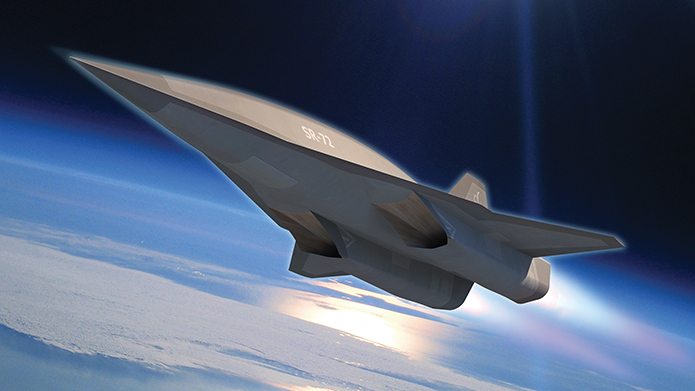
What is the SR-71's replacement? Why... it's the SR-72, of course. And it's not yet an official U.S. project; instead, Lockheed Martin (and some partners) have been working on their own to develop some of the technology to make a Mach 6 aircraft possible. The easy part: making it look awesome.

Still black, still a bird.


The hard part: propulsion. The materials needed for an airframe to survive hypersonic flight are well-known and tested. Manned aircraft like the X-15 have explored the flight regime. The Space Shuttle, of course, entered the atmosphere at near-orbital speeds, many times faster than that planned for the SR-72.

No, the problem is that traditional air-breathing engines generally only work well up to speeds of a Mach 2.2 or so--just more than twice the speed of sound. Beyond that, the air is moving too fast and is too hot to adequately compress inside the engine (compression and expansion being, essentially, the processes that give a jet its thrust).

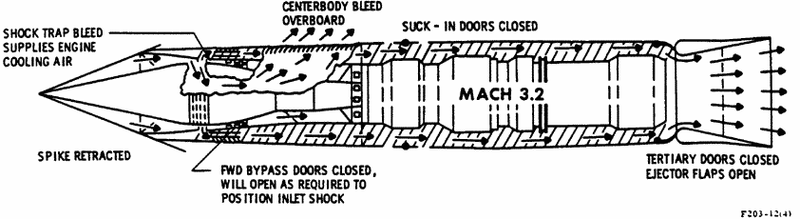
The SR-71 overcame that with clever engineering. Massive spikey things called, well, "spikes," were mounted in front of its J-58 engines and adjusted depending on how fast the aircraft was traveling.

To go fast, you have to slow the air down.

The spikes created a shockwave that fed air into the engines at a manageable velocity. But wait, there's more! The air heats up dramatically as it is slowed down--or actually accelerated, as the spike hits stationary molecules--because all that kinetic energy has to go somewhere. The hot air is much harder to compress. And less compression means less thrust. But The good people of Skunk Works had a solution for that too.

Skip the compressor--who needs it?


You with me? Large amounts of heated air were simply routed around the engine's core. That left cooler air to run through the compressor. But it also allowed the remaining air to be "reheated" in the exhaust--what is commonly called an afterburner. The compressor then ran more efficiently AND the volume of air passing through the engine was high enough that simply spraying fuel into the exhaust generated most of the engine's thrust at its top speed.

So those are the SR-71's engines. In effect, they went from being turbojets to near-ramjets at Mach 3.2.

This is important, because ramjets are needed for hypersonic flight. The techniques used in the SR-71 simply won't stand up at Mach 6, or six times the speed of sound--among other things, the temperatures are too extreme and the materials in the engines would simply melt.

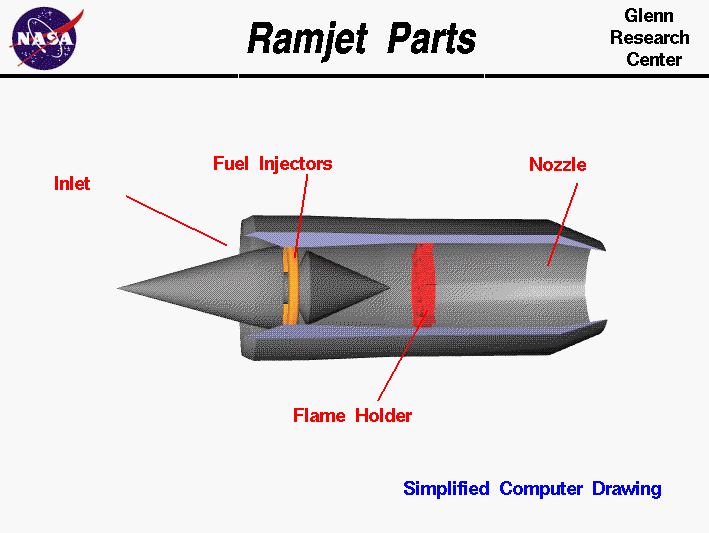
The solution is engines without any moving parts--the ramjet.


Cold air goes in, hot air comes out--it's that simple.


But this introduces another problem. Ramjets only work efficiently at speeds above Mach 4 or so... in other words, perhaps 500 mph faster than any jet-powered aircraft has flown. They don't work at all at a standstill. And that's a big problem if you want your aircraft to, you know, take off from a runway.

Lockheed Martin says it has solved this problem by putting both types of engines in the aircraft and tweaking both of them: the turbojet can go a little faster and the ramjet can get started a little slower.


Like this, but less vague.


The company won't say how, exactly, it has done this, but the engineers seem pretty confident:

“We have developed a way to work with an off-the-shelf fighter-class engine like the F100/F110,” notes Leland. The work, which includes modifying the ramjet to adapt to a lower takeover speed, is “the key enabler to make this airplane practical, and to making it both near-term and affordable,” he explains.
--snip--
Lockheed will not disclose its chosen method of bridging the thrust chasm. The company funded research and development, and “our approach is proprietary,” says Leland, adding that he cannot go into details. Several concepts are known, however, to be ripe for larger-scale testing, including various pre-cooler methods that mass-inject cooler flow into the compressor to boost performance. Other concepts that augment the engine power include the “hyperburner,” an augmentor that starts as an afterburner and transitions to a ramjet as Mach number increases. Aerojet, which acquired Rocketdyne earlier this year, has also floated the option of a rocket-augmented ejector ramjet as another means of providing seamless propulsion to Mach 6.

And with that issue solved, somehow, a Mach 6 aircraft is suddenly quite feasible.

To me, the entire thing is fascinating. I always loved the SR-71, which looks awesome and is awesome, so the idea of a successor that is twice as fast is beyond intriguing. But you know what else is intriguing? The fact that Lockheed Martin went public with this. If speed really is the new stealth, as the company puts it, why would you want to tip your hand?

Clearly, it's a business decision. Projects like this don't get built without a customer. And the only buyer is, of course, the U.S. government... which has had its share of budget issues lately. So you go public with something you think only you can pull off; this perception creates demand.

Lockheed Martin is also a player in the competition to build the Air Force's Long Range Strike Bomber. Putting some information out there that implies you can do something the other guys can't isn't a bad way to "taint the jury" for a contract that will be worth many billions of dollars.

And finally, the company has created value for itself. Its stock price jumped nearly $2 at one point on Friday. Getting your name in the news will do that.

So in the end, what is the SR-72? In my mind, it is probably a chess move--using a technical achievement to accomplish a long-term goal for the company. But in my aviation dork heart, I hope it becomes the real deal... faster, higher and awesomer than even the Blackbird.