Wednesday, November 27, 2013

Reblogging the blogs: a bloggy airborne odyssey

Yeah, yeah--I know, I have been absent for a bit again. But it's not that I haven't been blogging! It's that most of my aviation-related posts these days have wound up on another site. Allow myself to quote... myself.
This week, the Internet lit up with an annotated video of what appears to be China’s latest (or at least most recently unveiled) drone design.

The body resembles the United States’ Global Hawk, although perhaps a bit smaller. Its standout external features, though, are its joined wings — a sort of diamond shape formed by forward-swept wings mounted in the rear and backward-swept wings mounted in the front.
So that's one drone. Pretty neat looking. I'm not sure the joined-wing design really does much more than that at this point (and it's not at all clear this one is operational or more than a testbed), but it's an interesting airframe.


Then there's a little airplane-related commerce:

The market for the JF-17 fighter appears to be expanding in unexpected ways. At the Dubai Airshow, which opened on Sunday, the Pakistan Aeronautical Complex had a freshly minted example on display, complete with an array of Chinese-made missiles and bombs.

The Pakistani company jointly produces the plane with China’s Chengdu Aircraft Industry Corporation; the fighter is seen as one of China’s efforts to move up the value chain in arms exports. But according to recent news reports, Pakistan has plans to export the aircraft itself.
And finally, another Chinese drone:

Yet another Chinese drone variant has taken wing — and this one might be stealthy.
According to the state-run Global Times newspaper, the Lijian, or “Sharp Sword,” combat drone made its first flight on Thursday. The report said the flight lasted about 20 minutes and went without incident.

The English-language China Daily also carried a report on the Lijian.
The Lijian is different from other Chinese drones, such as the joined-wing design spotted a few weeks ago, in that it appears to be designed with stealth characteristics in mind. The contours are similar to those of the Lockheed Martin RQ-170 Sentinel and even the Northrop Grumman X-47B, which is in the midst of aircraft carrier landing trials. Dassault’s nEURon and BAE’s Taranis programs are also superficially similar.

The Lijian is interesting because it looks like this...


Sweet fake cockpit, Lijian.

... i.e., stealthy, and if it also IS stealthy, it could complicate things in the Pacific for the U.S. and Japan. A hard-to-detect drone can serve as a targeting node for anti-ship missiles, for one thing--and China depends on such missiles to keep hostile fleets away from its coasts.

Not that anyone is being hostile at the moment. But with China abruptly creating an "air identification defense zone" that happens to overlap with Japan's above the disputed island chain, and the U.S. reacting by flying two heavy bombers through the middle of it, it seems like tensions might go up a bit more before they subside. And, one hopes, that is where it ends.

Monday, November 4, 2013

Blacker bird

Last week, Lockheed Martin announced that it had a hypersonic replacement for the storied SR-71 Blackbird in the works. At this point, the most surprising element about it is that I haven't written about it yet. Bear with me--this post probably doesn't end how you think it will.

The story (linked above) was broken as an exclusive by Aviation Week. Lockheed has since posted its own news release on the subject, but that has really been the extent of the solid information out there. Much was rehashed over the weekend, so I'll do a "good parts" version here.

What is the SR-71's replacement? Why... it's the SR-72, of course. And it's not yet an official U.S. project; instead, Lockheed Martin (and some partners) have been working on their own to develop some of the technology to make a Mach 6 aircraft possible. The easy part: making it look awesome.

Still black, still a bird.


The hard part: propulsion. The materials needed for an airframe to survive hypersonic flight are well-known and tested. Manned aircraft like the X-15 have explored the flight regime. The Space Shuttle, of course, entered the atmosphere at near-orbital speeds, many times faster than that planned for the SR-72.

No, the problem is that traditional air-breathing engines generally only work well up to speeds of a Mach 2.2 or so--just more than twice the speed of sound. Beyond that, the air is moving too fast and is too hot to adequately compress inside the engine (compression and expansion being, essentially, the processes that give a jet its thrust).

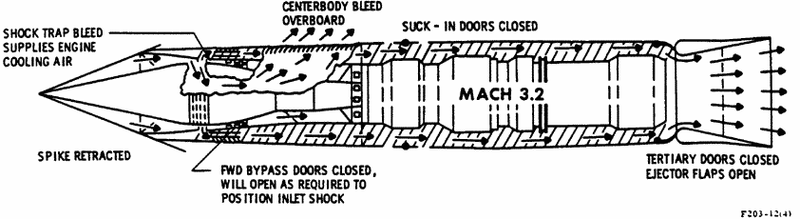
The SR-71 overcame that with clever engineering. Massive spikey things called, well, "spikes," were mounted in front of its J-58 engines and adjusted depending on how fast the aircraft was traveling.

To go fast, you have to slow the air down.

The spikes created a shockwave that fed air into the engines at a manageable velocity. But wait, there's more! The air heats up dramatically as it is slowed down--or actually accelerated, as the spike hits stationary molecules--because all that kinetic energy has to go somewhere. The hot air is much harder to compress. And less compression means less thrust. But The good people of Skunk Works had a solution for that too.

Skip the compressor--who needs it?


You with me? Large amounts of heated air were simply routed around the engine's core. That left cooler air to run through the compressor. But it also allowed the remaining air to be "reheated" in the exhaust--what is commonly called an afterburner. The compressor then ran more efficiently AND the volume of air passing through the engine was high enough that simply spraying fuel into the exhaust generated most of the engine's thrust at its top speed.

So those are the SR-71's engines. In effect, they went from being turbojets to near-ramjets at Mach 3.2.

This is important, because ramjets are needed for hypersonic flight. The techniques used in the SR-71 simply won't stand up at Mach 6, or six times the speed of sound--among other things, the temperatures are too extreme and the materials in the engines would simply melt.

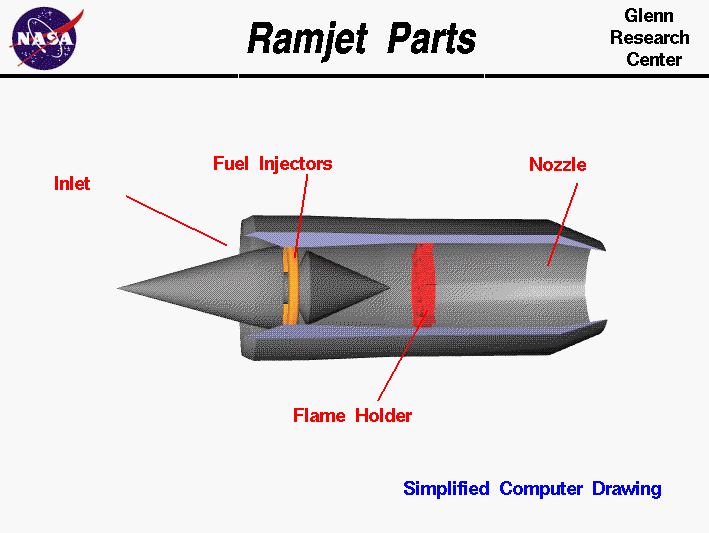
The solution is engines without any moving parts--the ramjet.


Cold air goes in, hot air comes out--it's that simple.


But this introduces another problem. Ramjets only work efficiently at speeds above Mach 4 or so... in other words, perhaps 500 mph faster than any jet-powered aircraft has flown. They don't work at all at a standstill. And that's a big problem if you want your aircraft to, you know, take off from a runway.

Lockheed Martin says it has solved this problem by putting both types of engines in the aircraft and tweaking both of them: the turbojet can go a little faster and the ramjet can get started a little slower.


Like this, but less vague.


The company won't say how, exactly, it has done this, but the engineers seem pretty confident:

“We have developed a way to work with an off-the-shelf fighter-class engine like the F100/F110,” notes Leland. The work, which includes modifying the ramjet to adapt to a lower takeover speed, is “the key enabler to make this airplane practical, and to making it both near-term and affordable,” he explains.
--snip--
Lockheed will not disclose its chosen method of bridging the thrust chasm. The company funded research and development, and “our approach is proprietary,” says Leland, adding that he cannot go into details. Several concepts are known, however, to be ripe for larger-scale testing, including various pre-cooler methods that mass-inject cooler flow into the compressor to boost performance. Other concepts that augment the engine power include the “hyperburner,” an augmentor that starts as an afterburner and transitions to a ramjet as Mach number increases. Aerojet, which acquired Rocketdyne earlier this year, has also floated the option of a rocket-augmented ejector ramjet as another means of providing seamless propulsion to Mach 6.

And with that issue solved, somehow, a Mach 6 aircraft is suddenly quite feasible.

To me, the entire thing is fascinating. I always loved the SR-71, which looks awesome and is awesome, so the idea of a successor that is twice as fast is beyond intriguing. But you know what else is intriguing? The fact that Lockheed Martin went public with this. If speed really is the new stealth, as the company puts it, why would you want to tip your hand?

Clearly, it's a business decision. Projects like this don't get built without a customer. And the only buyer is, of course, the U.S. government... which has had its share of budget issues lately. So you go public with something you think only you can pull off; this perception creates demand.

Lockheed Martin is also a player in the competition to build the Air Force's Long Range Strike Bomber. Putting some information out there that implies you can do something the other guys can't isn't a bad way to "taint the jury" for a contract that will be worth many billions of dollars.

And finally, the company has created value for itself. Its stock price jumped nearly $2 at one point on Friday. Getting your name in the news will do that.

So in the end, what is the SR-72? In my mind, it is probably a chess move--using a technical achievement to accomplish a long-term goal for the company. But in my aviation dork heart, I hope it becomes the real deal... faster, higher and awesomer than even the Blackbird.

Thursday, October 31, 2013

Highway to the by-the-book zone

War is Boring just did a great review of China's remake--apparently a nearly shot-for-shot version--of "Top Gun." It's called "Sky Fighters" and it looks like a mess.

"Top Gun" has always been one of my guilty (dorky?) pleasures, and I will never apologize for enjoying a well-filmed dogfight. But the same sequences in "Sky Fighters" look... well... boring. Take the "watch the birdie" scene, for example.


Fun! And it used, like, actual airplanes. The "Sky Fighters" version (the scene is at about 20:15) doesn't have real airplanes or even a rude gesture.


As the review notes, the main character doesn't have a cool callsign... he goes by "708." His wingman is "709." And his key talent is that he is a rigid doctrinaire. One might say he's not exactly a maverick. Ahem.

Anyway, the whole thing is on YouTube if you're into watching bad CGI, bad filmmaking and bad subtitles. But if you actually feel the need (the need for speed), fire up "Top Gun" instead.

Tuesday, October 29, 2013

It's that time of year


Ah, the winds of autumn. Here in Hong Kong, the signs are everywhere: leaves not falling from the trees, brisk chill absent from the air, apple cider and pumpkin spice lattes nowhere to be seen. (There are, however, plenty of people roasting chestnuts on streetcorners, but they do that during the summer too.)

And, oh yeah, college basketball. There's nary a sign of it in the 'Kong, but on Tuesday Kansas hits the court for the first time this season.


That's right--a shakycam video of a video screen in a basketball arena at... a glorified practice session this month. It doesn't get much dorkier than that. Fortunately, as noted above, actual basketball highlights are right around the corner. Happy autumn!

Monday, October 14, 2013

The IHT is dead--long live the IHT


Hello, readers. It has, once again, been too long since I've typed at you about bloggy things. The reason--honest--is that it has been busy times here at my desk in Hong Kong. Tomorrow, the International Herald Tribune becomes the International New York Times after being identified for years as "the global edition of the New York Times."

I didn't know a ton about the IHT before I moved overseas. But it's a name with a lot of history.

And more than that, it's a name you kind of expect to see in a sweltering hotel lobby in Hanoi or laid out among morning tea in Delhi. An expat fixture, in other words.


A famous guy reading a famous paper in a famous place.

So there are many arguments to be had over what's in a name (and there is an incredible retrospective here). But regardless of all that, it is a bit sad to see an element of old-school expat life disappear. See you in the funny papers, IHT....

Monday, September 30, 2013

Not-so-blurred vision

The other day I saw an interesting science- (and business-) related post about how Mercedes is equipping its latest models with something like active suspension: the car senses the road immediately ahead of it and adjusts accordingly. That's interesting in itself, but the story noted that Mercedes' ad campaign centered on how this was modeled on the way a chicken's vision works. The idea is that instead of simply "interpreting out" the chicken's movement from what it sees, the brain instead tells the bird's neck muscles to keep the head completely stationary.


This all came back to me this morning as I was dodging other pedestrians in the North Point train station. Despite my shucking, jiving and waiting for people to cram onto an escalator, my vision was clear. But my head was definitely moving. Our brains are big and complicated enough to not only do important things like invent sliced bread, but filter out our body's movements. That's one reason why you can play sports (and do other active things) without becoming horribly disoriented. Compare that to video shot from a head mounted camera, which obviously does not have the benefit of cranial editing. It can be vertiginous:


So in theory, if you put a chicken in a downhill bike race, the resulting footage would be much smoother. Also, you would have taught a chicken to ride a bike, which is a much bigger achievement, I'd say.

Anyway. Really not much more than a random though about how everyday activities are much more complicated than we give them credit for. And it's impressive that we can think about these things while walking, running, or even bobbing our heads to music.

Thursday, September 12, 2013

Schrodinger's baseball

Oh, hello, Readers of the Blog. It has, once again, been a while. This time is mostly because I was out of town on a thoroughly incredible vacation to Bali. I mean, I suppose I could have written a post or two while lounging next to this...


Making a splash in the jungle.

... but wouldn't I be better off just, you know, swimming? Yes. Yes, I would.

As I told Mrs. Blog, I had that old Eddie Money song stuck in my head toward the end of the trip. But unfortunately, the two tickets to paradise were round-trip, not one way. So I'm back now.

And, it turns out, I have missed a few things. Several Friends of the Blog have pointed out that the Kansas City Royals, who for years have existed basically to provide a reason to go sit outside and eat hot dogs in the summer, are now suddenly contenders. I am happy about this.

"Nice job. Nice job. Nice job. Nice job. Nice job."

I can't help but wonder whether there is some weird karmic correlation here, where the farther I get from K.C. the better the Royals do. Does simply checking the standings and noticing "Hey, they have stopped being terrible!" ruin their play? Is it like talking to a [REDACTED] in the eighth inning of a [REDACTED]?

The answer is almost certainly "no." And after all, I have already observed the cat--I mean, the baseball standings--so the observational damage is done. All that's left now is to enjoy the ride... and, I hope, the playoffs.