Tuesday, January 29, 2013

The little engines that can't

The Chinese aviation industry has been busy lately. Two stealthy looking fighters made big headlines, although their capabilities are suspect.

Now the Y-20 transport aircraft has made its debut, and the Chinese military says it will "enhance its global power projection."

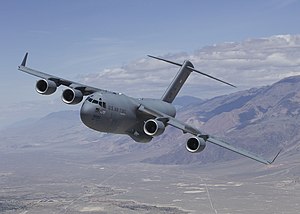
It's tough not to notice the similarities between the C-17 Globemaster III, the U.S. Air Force's workhorse transport aircraft, and the Y-20. The more cynical among us might suggest that the same Boeing blueprint is the basis for both--although the shared characteristics could just be a matter of two groups of engineers arriving at the same conclusions (which happened, for instance, with the Space Shuttle and its apparent doppelganger, the Buran).


C-17: Separated...


Y-20: ... at birth?

Anyway, graceful though the Y-20 may appear, it looks like it will be beset with many of the same issues that undercut the J-20 and J-31. Chief among those issues: the engines. You can build a spacious cargo hold, ingenious ramp design and robust wings, but without efficient engines, the power-projection abilities of a cargo aircraft are limited.

What's more, as defensetech.org notes, there is some doubt that China could have produced such a large airframe using mainly composite materials--a key factor in the C-17's long legs.
Chang also noted that the C-17’s long-range performance is possible because of the airplane’s composite materials, the manufacture of which the Chinese have struggled with to date.  And the Y-20 was likely to take at least another five years to enter operational service, he added.

So in the end, although another (literally) big project has (literally) gotten off the ground, the People's Liberation Army Air Force remains squarely behind the eight ball in terms of airlifting capability.

"Never start a land war in Asia," a wise man once said. This is dead-on in terms of China, which, thanks to geography and tremendous manpower, is not on anyone's list of places to invade. But despite all the talk of "strategic pivots" to face an "expansionist" China, the People's Liberation Army is unable to project much of its might far from home. The military cargo plane that can't fly from one end of China to the other without refueling is just the latest example.

Monday, January 28, 2013

The best defense....

In these heady days of McDonald's-dominated globalized economies, the idea of a world war seems far fetched. Resources, no matter how scarce, can always be traded for at a lower cost than mobilizing a military and doing some killin'. Conventional thinking is that small, "low-intensity" or "brush fire" conflicts will become more common even as large-scale confrontations become a thing of the past.

And it makes sense. Japan and China will posture for the fans back home about the national importance of some stupid islands, but in the end no one will pull a trigger... because even posturing carries economic consequences.

This is the way rational actors behave.

That leaves the other, crazier side of the coin to worry about. Places like North Korea, which by just about any standard seem to put somewhat random military goals above the welfare of their own people. Such "rogue states" are a major reason why the U.S. has poured billions of dollars into developing missile-defense systems of various kinds.

Some systems, like the one now deployed in Turkey, exist to shoot down shorter-range ballistic missiles that travel a few hundred miles and follow an unsophisticated ballistic trajectory. Thanks to math, they are easy to hit.

Other systems are designed to hit warheads in their "terminal" phase, which is to say after they are on their way down. This is tougher because not only are the warheads involved here generally traveling much faster, but they have to be completely destroyed or their explodey bits and pieces will continue on the same trajectory, landing more or less where they were aimed.


(Yes, that twisty maneuver at the beginning is deliberate.)


And finally, there's the toughest shot of all: the "mid-course" interception. Roughly put, this is the best time to blow up a missile, because it means it won't land where it is supposed to. It's also hard because it is incredibly high up--hundreds of miles--and involves tremendously high speeds.

The third one is probably most important if you're talking about dealing with serious threats from irrational actors. North Korea, for example, could use short-range missiles to hit Seoul, but would need an ICBM, perhaps modeled off their most recent successful rocket launch, to hit the United States.

And if you're shooting a missile that far, it's probably going to be a special delivery, i.e., nuclear, chemical or biological. Fun!

In terms of deterring people with huge arsenals, like Russia, anti-ballistic missile systems make little sense. Indeed, you could argue that they are not just a waste of money, but are destabilizing, because they offer one side the (false) belief that it could shoot first without suffering retaliation.

So again, that leaves the North Koreas of the world as the justification for developing these extremely tricky, extremely expensive systems.

It is on that note that we arrive at the punchline: China, North Korea's closest ally, just announced a "successful" test of a mid-course interception system.

China again carried out a land-based mid-course missile interception test within its territory Sunday.

Xinhua learned the news from the Information Bureau of China's Defense Ministry.

"The test has reached the preset goal," an official with the bureau said.

"The test is defensive in nature and targets no other country," he said.


For all the grumbling about U.S. interference in Asian affairs, it appears the continent's most powerful military is spending its money developing weapons to protect it not from a Western hegemony... but from its next-door neighbor.

Saturday, January 19, 2013

The Art of Old Guy Basketball, Part II

Good evening, dear readers. I write this to you from a chair, which is not in itself unusual, but it is a chair from which I will not easily rise. That's because for the first time since arriving in Hong Kong, I played ball.

Oh, yes.  The Parents of the Blog got me a basketball for Christmas. I had been in the market for one for a while; our digs in Hong Kong are basically surrounded by public sports facilities, including some nice basketball courts. Many a day I walked by, taunted by the pristine nets--not chains!--well-maintained backboards and playing surfaces that, as far as I could tell, appeared to be scrubbed weekly, if not daily.

Someone pays close enough attention to the courts that the trapezoidal "international" foul lane…

The geometry makes it more fair, or something.

… had been scrubbed out at some point and replaced with the NCAA standard free-throw lane. Not only that, but the NCAA three-point line, which was recently moved to 20 feet, 9 inches, was up to standard. And you could see where the old one was before the groundskeepers scrubbed it off.

How to use the NCAA three-point line.

Anyway, the point is, I had been wanting to get out and see how bad my shot had gotten since hooping it up in the Middle East. Today, I did it (after buying an air pump at Toys R US. Don't judge; the sporting goods store was "sold out" of pumps).

The result is, as I mentioned above, extremely sore knees. But I finally got a glimpse of what street basketball in Hong Kong means, at least in our little overplanned high-rise forest of a neighborhood. Several observations:

1) On the courts where I was playing, everyone wanted to be a guard.

2) No one played a ton of defense.

3) The average height was greater than that of the rest of Hong Kong, but still less than 6-foot-3, i.e., me.

That meant several things. Point (1) meant that I, a guy who somehow managed to be a post player in high school (second-most blocked shots in freshman history, holla!), had an advantage in not just height but know-how. Everyone was willing to give up position in the paint, no one seemed to see my patented, and by that I mean totally telegraphed, shoulder-fake coming, and I boxed the hell out of anything that moved.

Point (2) meant that when I did get away from the basket, I could square my shoulders, set my feet, not jump, and have a clean look at the hoop. It also meant that by playing any defense AT ALL, I could affect the game. This type of nominal guarding saved me the embarrassment of wheezing to a halt on a court full of young whippersnappers.

Point (3) meant the obvious--even my 36-year-old, bad-kneed self could get away with not jumping a whole lot and still getting rebounds, blocking shots, and so on.

In short: It was the perfect recipe for a game of Old Guy Basketball. I didn't dribble much. I passed a lot. I didn't shoot more than a couple of times beyond three feet. I was probably really annoying to anyone chasing a rebound under the basket.

And my team won.

I will take comfort in that as I ice my knees.

Monday, December 24, 2012

It's Christmas Eve, Babe

It's time of year again, Gentle Readers of the Blog, this time in the festively adorned Hong Kong. So pull up some nog, light a fire if you have a safe place to do so, and enjoy one of the most bittersweetest of bittersweet holiday songs ever in a Read Ink tradition.


Merry Christmas, Happy Holidays, and a Spectacular Et Cetera to you all!

Wednesday, December 19, 2012

The gift that keeps on giving*

Happy Holidays, dear readers. Shopping season is in its last violent throes; Hong Kong, for one, is overrun with people buying even more stuff than they usually do. I wouldn't go inside Sogo right now if you paid me.

But if you're looking for the perfect present that won't break the bank, have I got a great suggestion for you. It ticks off all the elements you could possibly want: Cheap (in this case, free), unusual, colorful, fun.

I am of course talking about a North Korean-made driving game in which you motor around a digitized Pyongyang.


Probably higher-resolution than the actual city.

Play it here, Comrades. And a Very Merry Dear Leadermas to you.

*until you violate the rules of the road and are thrown into a reeducation camp.

Sunday, December 9, 2012

A farewell to good grammar

I'd like to think I'm still too young to be a curmudgeon, but every once in a while I spot something that, linguistically speaking, makes me want to scream "Get off my lawn!"

In this case, it's the main headline on the homepage of a certain international news organization that will remain nameless.


Dios mio.


I have never been a grammar dork (no, really, I'm serious), but I appreciate good English and have been known to write a headline or two in my day. Using "farewell" as a verb... that's just viscerally painful. It doesn't even sound right! Sure, sure--it's a tight space for a headline, but come on, I promise you there is a two-line hed somewhere in the universe that will accommodate crazy stuff like the rules that govern the English language.

That's my rant. Now I'm off to the 5 p.m. buffet before Wheel of Fortune comes on.

Sunday, December 2, 2012

Rockin' around the Clocken

One of the unfortunate things about life in the Middle East was the lack of a genuine local music scene. There were bands everywhere--including some truly killer cover bands--and big shows came through every couple of months, but there wasn't a lot of local musical innovation.

So it was with great pleasure that Mrs. Blog, the Sister-in-Law of the Blog and some Friends of the Blog came face to face with Chochukmo, a local band from Hong Kong. We were spending our Saturday night at an annual music festival with the unfortunate name of Clockenflap.

Note the classic "singing into the audio monitor" pose.

They put on a great show, with a lead singer whose body language could accurately be described as Jaggeresque and a broad-spectrum sound that the kids these days apparently call "math rock."

And the setting was terrific, too. It was cool and a little rainy, but the West Kowloon Cultural District is right on Victoria Harbor, meaning every performance had a spectacular, multicolored backdrop (or sidedrop, whatever).


Note the two giant Christmas trees.

Sure, the crowd made me feel slightly old at times (Hey! You kids! Quit with yer crowd-surfin', I can't see!), but it's hard to beat live, outdoor music on a Saturday night. And it's always good to hear a new band, even if I'm not totally sure how to pronounce its name.